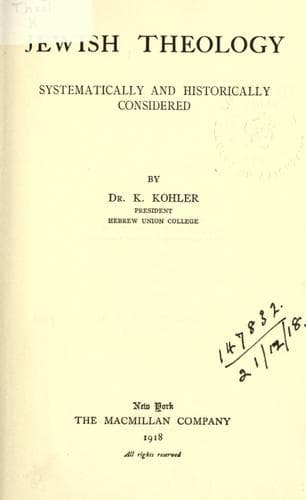
Jewish Theology, Systematically and Historically ConsideredKohler, Kaufmann
Religion
Jewish Theology, Systematically and Historically Considered
Kohler, Kaufmann
Judaism -- Doctrines
7. Christianity’s origin from Judaism is proved by its religious documents
as well as by its very name, which is derived from the Greek for the title
Messiah (_Christos_), bestowed on the Nazarene by his followers. Still the
name Christianity arose in Antioch among non-Jews who scarcely knew its
meaning. All the sources of the New Testament, however much they conflict
in details, agree that the movement of Christianity began with the
appearance of John the Baptist, a popular Essene saint. He rallied the
multitude at the shore of the Jordan, preparing them for the approaching
end of the Roman world-kingdom with the proclamation, “Wash yourselves
clean from your sins!” that is, “Take the baptismal bath of repentance,
for the kingdom of heaven is nigh.”(1396) He conferred the baptismal bath
of repentance upon Jesus of Nazareth and the first apostles.(1397) Jesus
took up this message when John was imprisoned and finally killed by Herod
Antipas on account of his preachment against him.(1398) The life of Jesus
is wrapt in legends which may be reduced to the following historical
elements:(1399) The young Nazarene was of an altogether different
temperament from that of John the Baptist, the stern, Elijah-like preacher
in the wilderness;(1400) he manifested as preacher and as a healer of the
sick a profound love for, and tender sympathy with suffering humanity, a
trait especially fostered among the Essenes. This drew him toward that
class of people who were shunned as unclean by the uncompromising leaders
of the Pharisees, and also by the rigid brotherhoods of the Essenes, whose
chief object was to attain the highest degree of holiness by a life of
asceticism. His simple countrymen, the fishers and shepherds of Galilee,
on hearing his wise and humane teachings and seeing his miraculous cures,
considered him a prophet and a conqueror of the hosts of demons, the
workers of disease. In contrast to the learned Pharisees, he felt it to be
his calling to bring the good tidings of salvation to the poor and
outcast, to “seek the lost sheep of the house of Israel” and win them for
God. He soon found himself surrounded by a multitude of followers, who, on
a Passover pilgrimage to Jerusalem, induced him to announce himself as the
expected Messiah. He attracted the people in Jerusalem by his vehement
attacks upon the Sadducean hierarchy, which he threatened with the wrath
of heaven for its abuses, and also by his denunciations of the
self-sufficient Pharisean doctors of the law. Soon the crisis came when he
openly declared war against the avarice of the priests, who owned the
markets where the sacrificial fowl for the Temple were sold, overthrowing
the tables of the money-changers, and declaring the Temple to have become
“a den of robbers.”(1401) The hierarchical council delivered him to
Pontius Pilatus, the Roman prefect, as an aspirant to the royal title of
Messiah, which in the eyes of the Romans meant a revolutionary leader. The
Public-domain text, read in full here on John Shaqi.
Reviews
Reviews
No reviews yet
Be the first to share your thoughts on this work.
Elsewhere in the archive
Join the Discussion
Join the discussion
Sign in to leave a comment or review.
Sign InorCreate an account