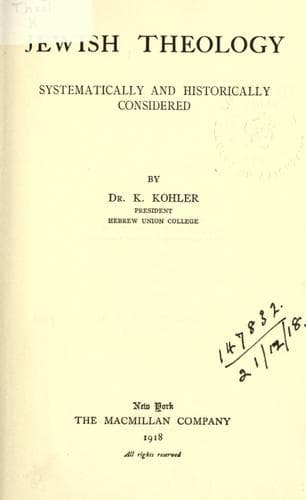
Jewish Theology, Systematically and Historically ConsideredKohler, Kaufmann
Religion
Jewish Theology, Systematically and Historically Considered
Kohler, Kaufmann
Judaism -- Doctrines
An older and probably more original form of the parable was discovered by
Steinschneider in a work by Abraham Abulafia of the thirteenth century,
running as follows: “A father intended to bequeath a precious jewel to his
only son, but was exasperated by his ingratitude, and therefore buried it.
His servants, however, knowing of the treasure, took it and claimed to
have received it from the father. In the course of time they became so
arrogant that the son repented of his conduct, whereupon the father gave
him the jewel as his rightful possession.” The story ends by stating that
Israel is the son and the Moslem and Christian the servants.
Beside this witty solution of a delicate problem, some Mohammedans made
attempts very early, doubtless on account of discussions with learned
Jews, to prove the justification of the three religions from the Jewish
Scriptures themselves. Thus they referred the verse speaking of the
revelation of God on Sinai, Mount Seir, and Mount Paran(1394) to the
religious teachings of Moses, Jesus, and Mohammed. Naturally, the Jewish
exegetes and philosophers objected vigorously to such an interpretation.
6. The question which religion is the best, has been most satisfactorily
answered for Judaism by R. Joshua ben Hanania, who said that “the
righteous of the heathen have also a share in the world to come.”(1395)
The question which religion is true, has been, alas, too long arbitrated
by the sword, and will be decided peacefully only when the whole earth
will be full of the knowledge of God. Our own age, however, has begun to
examine the title to existence of every religion from the broad standpoint
of history and ethnology, assigning to each its proper rank. In this large
purview even the crude beliefs of savages are shown to be of value, and
the various heathen religions are seen to have a historical task of their
own. Each of them has to some extent awakened the dormant divine spark in
man; one has aided in the growth of the ideal of the beautiful in art,
another in the rise of the ideal of the true in philosophy and science; a
third in the cultivation of the ideal of the good and in stimulating
sympathy and love so as to ennoble men and nations. Thus after a careful
examination of the historical documents of the Christian and Mohammedan
religions, it is possible to state clearly their great historic mission
and their achievements in the whole domain of civilization. The Jewish
religion, as the mother who gave birth to both, must deliver the verdict,
how far they still contribute to the upbuilding of God’s kingdom on earth.
In fulfilling their appointed mission, each has given rise to valuable and
peculiar institutions, and each has fallen short of the Messianic ideal as
visualized by our great prophets of old. Only an impartial judgment can
say which one has reached the higher stage of civilization.
Public-domain text, read in full here on John Shaqi.
Reviews
Reviews
No reviews yet
Be the first to share your thoughts on this work.
Elsewhere in the archive
Join the Discussion
Join the discussion
Sign in to leave a comment or review.
Sign InorCreate an account