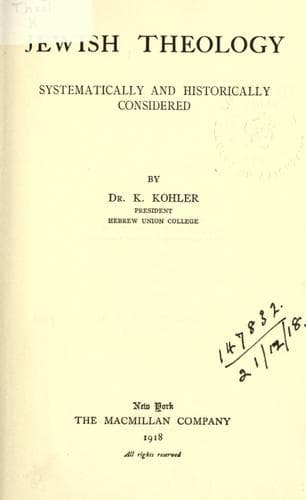
Jewish Theology, Systematically and Historically ConsideredKohler, Kaufmann
Religion
Jewish Theology, Systematically and Historically Considered
Kohler, Kaufmann
Judaism -- Doctrines
preliminary to marriage,(1437) but in Jewish life it assumed a religious
meaning and became endeared to the people as the consecration of the child
as the future head of a family. The idea underlying the institution (as
Zunz correctly calls it)(1438) is the sanctification of the Jewish
household as represented by its male members. The member of a people that
is to be holy unto God must bear the seal of the covenant on his flesh; as
a potential father of another generation, the sign he bore had a deeper
meaning for the future of the people.(1439) The rationalistic view that
the Mosaic law is merely hygienic, although found as early as Philo, is
quite erroneous.(1440)
5. The same rationalist view(1441) is often applied to the dietary laws of
the Mosaic Code, but without any justification from the Biblical point of
view. These laws prohibit as unclean various species of animals, or such
as have fallen dead or as the prey of wild beasts, or certain portions
like blood and suet.(1442) The Holiness Code states its reason for these
prohibitions very emphatically: “I am the Lord your God, who have set you
apart from the peoples. Ye shall therefore separate between the clean
beast and the unclean, and between the unclean fowl and the clean; and ye
shall not make your souls detestable by beast, or by fowl, or by any thing
wherewith the ground teemeth, which I have set apart for you to hold
unclean. And ye shall be holy unto Me; for I the Lord your God am holy,
and have set you apart from the peoples, that ye should be Mine.”(1443)
The Deuteronomic Code gives the same reason for the prohibition of the
unclean beasts: “For thou art a holy people unto the Lord thy God.” It
seems that these prohibitions of “unclean” foods were intended originally
for the priesthood and other holy men, as appears in Ezekiel and
elsewhere.(1444) As a matter of fact, the same class of animals from which
the Israelites were commanded to abstain were also forbidden to the
priests or saints of India, Persia, Mesopotamia, and partly of
Egypt.(1445) The natural conclusion is that the Mosaic law intended these
rules as a practical expression of its general principle that Israel was
to be “a kingdom of priests and a holy nation.”(1446) In other words,
Israel was to fill the usual place of the priest among the nations of the
ancient world, a priest-people observing the priestly laws of
sanctification. Whatever the origin of these customs may have been,
whether they were tabu laws in connection with totemism or some other
primitive view, the Priestly Code itself admits their lack of an
Israelitish origin by recognizing that they were known to Noah.(1447) They
were simply adopted by the law-giver of Israel to make the whole people
feel their priestly calling.
Public-domain text, read in full here on John Shaqi.
Reviews
Reviews
No reviews yet
Be the first to share your thoughts on this work.
Elsewhere in the archive
Join the Discussion
Join the discussion
Sign in to leave a comment or review.
Sign InorCreate an account