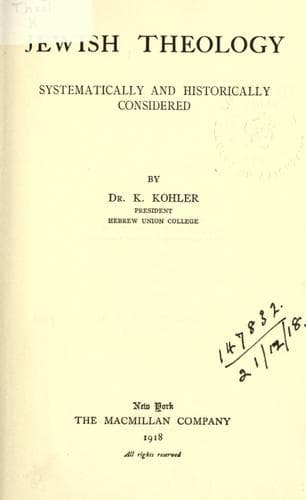
Jewish Theology, Systematically and Historically ConsideredKohler, Kaufmann
Religion
Jewish Theology, Systematically and Historically Considered
Kohler, Kaufmann
Judaism -- Doctrines
In later times the dietary laws, especially abstinence from the flesh of
swine, became a mark of distinction which separated the Jew from his
heathen surroundings; and they became a symbol of Jewish loyalty in the
Syrian persecutions when pious Jews faced martyrdom for them as willingly
as for the refusal to adore the Syrian idols.(1448) In fact, Pharisaism
adopted the principle of separation from the heathen in every matter
pertaining to diet, and this spirit of separatism was strengthened by the
scorn of the Greeks and Romans and afterward by the antinomian spirit of
Christianity. While Hellenistic writers, eager to find a universal meaning
in these laws, assigned certain physical or psychic reasons for
them,(1449) the rabbis of the Talmud insisted that they were given solely
for the moral purification of Israel. Thus they were to be observed as
tests of Israel’s submission to the divine will and not because of
personal distaste. In their own words, “We must overcome all desire for
the sake of our Father in heaven”; and “Only to those who wrestle with
temptation does the kingdom of God come.”(1450) In the course of time
these prohibitions were steadily extended, until they encircled the whole
life of the Jew, forming an insurmountable wall which secluded him from
his non-Jewish environment. Finally, separation from the world came to be
regarded as an end in itself.(1451)
Now, it cannot be denied that these laws actually disciplined the medieval
Jew, so that during centuries of wild dissipation he practiced sobriety
and moderation; as Maimonides says,(1452) they served as lessons in
self-mastery, in curbing carnal desire, and keeping him clean in soul as
well as body. The question remains whether they still fulfill their real
object of consecrating Israel to its priestly mission among the nations.
Certainly the priestly character of these laws is no longer understood,
and the great majority of the Jewish people who live among the various
nations have long discarded them. Orthodox Judaism, which follows
tradition without inquiring into the purpose of the laws, is entirely
consistent in maintaining the importance of every item of the traditional
Jewish life. Reform Judaism has a different view, as it sees in the
humanitarianism of the present a mode of realizing the Messianic hope of
Israel. Therefore it cannot afford to encourage the separation of the Jew
from his environment in any way except through the maintenance of his
religion, and cannot encourage the dietary laws as a means of separatism.
Its great problem is to find other methods to inculcate the spirit of
holiness in the modern Jew, to render him conscious of his priestly
mission, while he lives in unison and fellowship with all his
fellow-citizens.(1453)
Public-domain text, read in full here on John Shaqi.
Reviews
Reviews
No reviews yet
Be the first to share your thoughts on this work.
Elsewhere in the archive
Join the Discussion
Join the discussion
Sign in to leave a comment or review.
Sign InorCreate an account