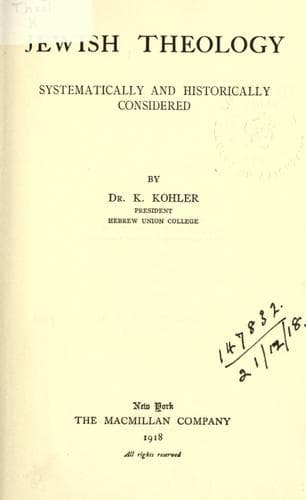
Jewish Theology, Systematically and Historically ConsideredKohler, Kaufmann
Religion
Jewish Theology, Systematically and Historically Considered
Kohler, Kaufmann
Judaism -- Doctrines
6. The tendency to distinguish the Jew from his non-Jewish neighbor in the
course of time found expression in the laws for wearing phylacteries
(_tefillin_) on his forehead and arm, a special sign on the doorpost of
his house (_mezuzzah_) and fringes (_zizith_) on the four corners of his
shawl (_tallith_).(1454) As a matter of fact, the original Biblical
passages had no such meaning, but acquired it through rabbinical
interpretation. The Mosaic law said: “And thou shalt bind them for a sign
upon thy hand, and they shall be for frontlets between thine eyes. And
thou shalt write them upon the doorposts of thy house and upon thy gates.”
This refers clearly to the words of God, admonishing the people to keep
them in mind, as the preceding verse indicates. Likewise, the precept
regarding the fringes upon the four-cornered garment emphasizes rather the
blue thread in the fringes, which is to help the people remember the
commandments of the Lord, that they may not go astray, “following after
the promptings of their own hearts and eyes.” As the name phylacteries
shows, these were originally talismans or amulets. True, the law as stated
in Deuteronomy may be taken symbolically;(1455) but the corresponding
passage in Exodus, which is traditionally referred to the phylacteries,
indicates its origin by its close relation to the Passover sacrifice. The
blood of this was, no doubt, put originally on the arm and forehead,(1456)
which is still done by the Samaritans(1457) and has striking parallels in
the practice of the Fellahin in Palestine and Syria.(1458) Originally the
sacrificial blood was supposed to ward off evil spirits from men, beasts
and houses or tents, and gradually this pagan custom was transformed into
a religious precept to consecrate the body, life, and home of the Jew. In
more ancient times the phylacteries were worn by pious men and women all
day and not merely during the time of prayer, and seem to have served both
as a religious symbol and an amulet. This was certainly the case with the
_mezuzzah_ on the doorpost and probably with the blue thread at the
corners of the _tallith_.(1459) As both phylacteries and _tallith_ came
into use at the divine service in connection with the recital of the
_Shema_ and the chapter on the _zizith_, the symbols assumed a higher
meaning. Arrayed in his vestments, the pious Jew offered daily allegiance
to his Maker, feeling that he was thereby protected from evil within and
without; similarly, the sacred sign upon the door both consecrated and
protected his home. Even with this conception the talismanic character was
never quite forgotten. Throughout the Middle Ages these ceremonies were
observed as divine commandments; and tradition having seemingly fixed them
for all time, the Jew took great pride in the fact that he was
“distinguished” in many ways, and especially in his forms of
worship.(1460) Of course, they distinguished him far more when these
ceremonies were practiced for the entire day.
Public-domain text, read in full here on John Shaqi.
Reviews
Reviews
No reviews yet
Be the first to share your thoughts on this work.
Elsewhere in the archive
Join the Discussion
Join the discussion
Sign in to leave a comment or review.
Sign InorCreate an account