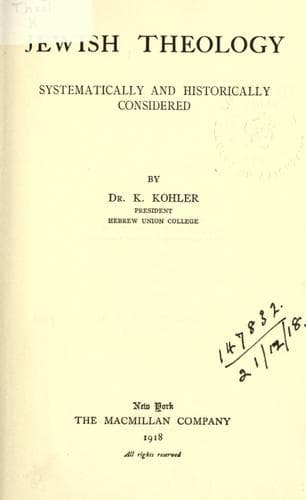
Jewish Theology, Systematically and Historically ConsideredKohler, Kaufmann
Religion
Jewish Theology, Systematically and Historically Considered
Kohler, Kaufmann
Judaism -- Doctrines
These two views, in turn, gave rise to different conceptions of the
Sabbath laws. Many ancient teachers laid chief stress on the letter of the
law which bids men cease from labor. Others, who penetrated farther into
the spirit of Deuteronomy and the Covenant Code, emphasized the human need
for relaxation and refreshment of soul. The older school, especially the
Sadducees, demanded absolute cessation of labor on pain of death for any
work, however insignificant, and even for the moving from one place to
another. They thought of the Sabbath as a sign of the covenant between God
and Israel, and hence held that it should be observed as punctiliously as
possible.(1465) In the same measure as the Pharisees, with their program
of religious democracy and common sense, obtained the upper hand, the
Biblical strictness of the Sabbath law was modified. The term labor was
defined by analogy with the work done for the tabernacle, and so
restricted as to make the death penalty much more limited.(1466) Moreover,
the Pharisees held that the Sabbath was made for man, not man for the
Sabbath;(1467) so, although they adhered strictly to the prohibition of
labor, the Sabbath received at their hands more of the other element, and
became a day for the elevation of the soul, “a day of delight” for the
spirit.(1468) The whole man, body and soul alike, should enjoy God’s gifts
more fully on this day; he should cast off care and sanctify the day by
praise offered to God at the family table. At a very early period in
Israel the Sabbath was distinguished by the words of instruction and
comfort offered by the prophets to the people who consulted them on the
day of rest.(1469) During the Exile and afterward the people assembled on
the Sabbath to hear the word of God read from the Torah and the prophets
and to join in prayer and song, which soon became a permanent
institution.(1470) Thus the Sabbath elevated and educated the Jewish
people, and afterward transferred its blessings also to the Christian and
Mohammedan world. Especially during the Middle Ages the Sabbath became an
oasis, a refreshing spring of water for the Jew. All through the week he
was a Pariah in the outside world, but the Sabbath brought him bliss in
his home and spiritual power in his Synagogue and school. Cheerfully he
bore the yoke of statutes and ordinances that grew ever heavier under the
rabbinical amplification; for he hailed the Sabbath as the “queen” that
raised him from a hated wanderer to a prince in his own domain.(1471)
Public-domain text, read in full here on John Shaqi.
Reviews
Reviews
No reviews yet
Be the first to share your thoughts on this work.
Elsewhere in the archive
Join the Discussion
Join the discussion
Sign in to leave a comment or review.
Sign InorCreate an account