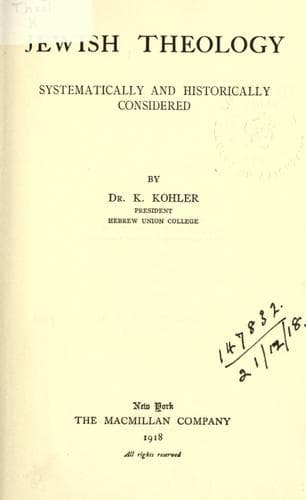
Jewish Theology, Systematically and Historically ConsideredKohler, Kaufmann
Religion
Jewish Theology, Systematically and Historically Considered
Kohler, Kaufmann
Judaism -- Doctrines
Modern life has worked great changes in the Jewish observance of the
Sabbath. Caught up in the whirl of commercial and industrial competition,
the Jew, like Ixion in the fable, is bound to his wheel of business, and
enjoys neither rest for his body nor elevation for his soul on God’s holy
day. True, the Synagogue still preserves the sanctity of the ancient
Sabbath, however small may be the attendance at the divine service, and in
many pious homes the family still rallies around the festive table,
lighted by the Sabbath lamp and decorated by the symbolic cup of wine. But
for the majority of Western Jews the Sabbath has lost its pristine
sanctity and splendor, to the great detriment of Jewish religious life.
Therefore many now ask: “Is it sufficient to have a vicarious observance
of the historical Sabbath, the ‘sign between God and Israel,’ by an hour
or two in the Synagogue, but without rest for the entire day? Or shall the
civic day of rest, though Christian in origin and character, take the
place of the Jewish Sabbath with its sacred traditions, so that possibly
at last it may become the Sabbath day predicted by the seer upon which
‘all flesh shall come to worship before the Lord’?”(1472) In the halcyon
days of the reform movement in Germany this view was often expressed when
the radical reformers celebrated the civic day of rest as the Jewish
Sabbath, not in the spirit of dissension, but for the sake of giving
Judaism a larger scope and a wider outlook. In America, too, the idea of
transferring the Sabbath to Sunday was broached by some leading Reform
rabbis and met with hearty support on the part of their congregations.
Since then a more conservative view has taken hold of most of the liberal
elements of Jewry also in America. While divine service on Sundays has
been introduced with decided success in many cities and eminent preachers
bring the message of Judaism home to thousands that would otherwise remain
strangers to the house of God and to the influence of religion, the
conviction has become well established that the continuity with our great
past must be upheld, and the general feeling is that the historical
Sabbath should under no condition be entirely given up. It is inseparably
connected with the election of Israel as a priest-people, while the
Christian “Lord’s Day” represents views and tendencies opposed to those of
Judaism, whether considered in its original meaning or in that given it by
the Church.(1473) The Jew may properly use the civic day of rest in common
with his Christian fellow-citizen for religious devotion and instruction
for young and old; it will supplement his neglected Sabbath service, until
conditions have changed. Perhaps the Jew in Mohammedan countries may even
at some time observe Friday as is done by the Mosque, and accordingly
consecrate this day in common with his fellow-citizens. Still, between the
Sabbath observed by the Church and the one of the Mosque stands the Jewish
Public-domain text, read in full here on John Shaqi.
Reviews
Reviews
No reviews yet
Be the first to share your thoughts on this work.
Elsewhere in the archive
Join the Discussion
Join the discussion
Sign in to leave a comment or review.
Sign InorCreate an account