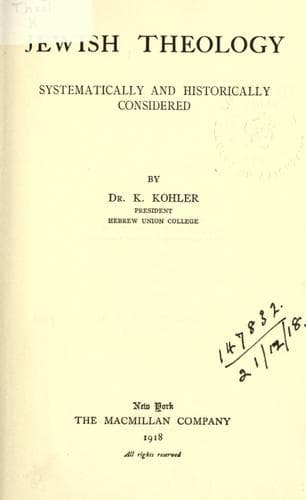
Jewish Theology, Systematically and Historically ConsideredKohler, Kaufmann
Religion
Jewish Theology, Systematically and Historically Considered
Kohler, Kaufmann
Judaism -- Doctrines
9. The various Jewish festivals, like the Sabbath, were detached from
their original relation to nature and turned into historical memorials,
eloquent testimonies to the great works of God and of Israel’s power of
rejuvenation. The Passover was originally the spring festival of the
shepherds when they hallowed the thresholds,(1481) but was later
identified with the agricultural Feast of Unleavened Bread in Palestine,
and at an early period was further transformed into a festival of
redemption. The former rites of consecration of tent and herd were taken
as symbols of the wondrous deliverance of the Hebrews from the Egyptian
yoke. The sacrifice of the “passing over the threshold,” with the
sprinkling of the blood on the doorposts and lintels of each house,
observed each spring exactly as is still done among the semi-pagan
inhabitants of Syria and Arabia, was reinterpreted. According to the
Mosaic code it indicated the wondrous passing of the angel of death over
the thresholds of the Israelites in Egypt, while he entered the homes of
the Egyptians to slay the first-born and avenge the wrongs of
Israel.(1482) Likewise the cakes of bread without leaven (the _Mazzoth_)
baked for the festival were taken as reminders of the hasty exodus of the
fathers from the land of oppression. Thus the spring festival became a
memorial of the springtime of liberty for the nation and at the same time
a consecration of the Jewish home to the covenant God of Israel. God was
to enter the Jewish home as He did in Egypt, as the Redeemer and Protector
of Israel. Young and old listened with perennial interest to the story of
the deliverance, offering praise for the wonders of the past and voicing
their confidence in the future redemption from oppression and woe.
However burdensome the Passover minutiæ, especially in regard to the
prohibition of leaven, became to the Jewish household, the predominant
feature was always an exuberance of joy. In the darkest days of
medievalism the synagogue and home resounded with song and thanksgiving,
and the young imbibed the joy and comfort of their elders through the
beautiful symbols of the feast and the richly adorned tale of the
deliverance (the _Haggadah_). The Passover feast with its “night of divine
watching” endowed the Jew ever anew with endurance during the dark night
of medieval tyranny, and with faith in “the Keeper of Israel who
slumbereth not nor sleepeth.”(1483) Moreover, as the springtide of nature
fills each creature with joy and hope, so Israel’s feast of redemption
promises the great day of liberty to those who still chafe under the yoke
of oppression. The modern Jew is beginning to see in the reawakening of
his religious and social life in western lands the token of the future
liberation of all mankind.(1484) The Passover feast brings him the clear
and hopeful message of freedom for humanity from all bondage of body and
of spirit.
Public-domain text, read in full here on John Shaqi.
Reviews
Reviews
No reviews yet
Be the first to share your thoughts on this work.
Elsewhere in the archive
Join the Discussion
Join the discussion
Sign in to leave a comment or review.
Sign InorCreate an account