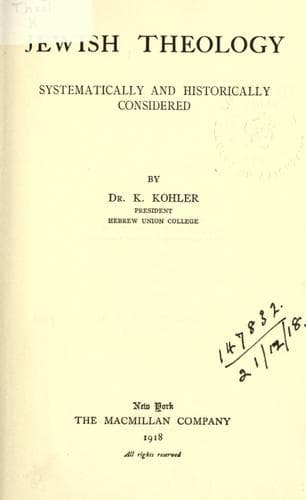
Jewish Theology, Systematically and Historically ConsideredKohler, Kaufmann
Religion
Jewish Theology, Systematically and Historically Considered
Kohler, Kaufmann
Judaism -- Doctrines
Sabbath in solemn grandeur and patriarchal dignity, waiting with Israel,
its keeper and ally, for the day when all humanity will worship the one
holy God of Abraham, and when our ancient Sabbath may truly become the
Sabbath of the world.
8. In all lands time was originally regulated by the movements of the
moon, which are within the observation of all. The alternation of its
increase and decrease divided the month into two parts, which were then
subdivided into four. Therefore the original month among both the
Babylonians and the Hebrews consisted of four weeks of seven days each,
the last day of each week being the Sabbath, the “day of standstill,” and
two days of the new moon.(1474) Both the new moon and full moon were
special days of celebration,(1475) and later two other Sabbath days were
added between them to correspond to the four phases of the moon. Still
later the week was detached altogether from the moon and made a fixed
period of seven days, solemnly ended by the Sabbath. Thus Judaism raised
the Sabbath above all dependence on nature and into the realm of holiness.
The Jewish Sabbath became the witness to God, the Creator ruling above
nature in absolute freedom.(1476)
Still the ancient festival of the new moon was preserved as an observance
in the Temple, and it afterward survived only in the liturgy of the
Synagogue. While ancient Israel had observed the New Moon as a day of rest
even more sacred than the Sabbath,(1477) the Priestly Code placed it among
the festivals only as a day of sacrifice, but as neither a day of rest nor
of popular celebration.(1478) Beside the recital of the _Hallel_ Psalms
and the _Mussaf_ (“additional”) prayer in the Synagogue no religious
significance was attached to it in the daily life of the people. Still the
fact that the Jewish calendar was regulated by the moon, while that of
other nations depended on the solar year, led the rabbis to compare the
unique history of Israel to the course of the moon. As the moon changes
continually, waxing and waning but ever renewing itself after each
decline, so Israel renews itself after every fall; while the proud nations
of the world, which count their year by the course of the sun, rise and
set, as it does, with no hope of renewal.(1479) At the same time,
assurance was found in the prophetic words that “the light of the moon
shall be as the light of the sun and the light of the sun shall be
sevenfold as the light of the seven days” and “thy (Israel’s) sun shall no
more go down, neither shall thy moon withdraw itself, for the Lord shall
be thine everlasting light.”(1480)
Public-domain text, read in full here on John Shaqi.
Reviews
Reviews
No reviews yet
Be the first to share your thoughts on this work.
Elsewhere in the archive
Join the Discussion
Join the discussion
Sign in to leave a comment or review.
Sign InorCreate an account