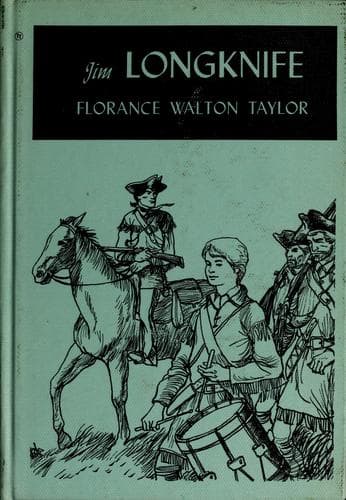
“A likely story,” muttered the shorter man. “Probably you’re some spy
sent out by the Indians.”
Jim shook his head. “No, sir. I saw a big band of Long-Knives yesterday
and I’ve been trying to find them.”
“Let’s take him to Colonel Clark,” the shorter man suggested.
Jim’s eyes sparkled. “Clark, did you say? George Rogers Clark? Is he
red-haired?”
The tall soldier spoke again. “Say, boy, you know too much. Come on, get
going.”
As they walked single file through the woods, they made Jim walk between
them. After stumbling over fallen trees and brambles for about a mile,
they came upon a group of ragged men sitting and standing in the dense
shade along a river.
“Colonel Clark, sir,” began the tall soldier, “we’ve found a white boy;
he says he was a prisoner of the Indians. But he knows too much. Must be
some trick here.”
A ragged, commanding figure with red hair turned from the men and walked
over to Jim. His stern, hazel eyes seemed to penetrate Jim’s whole body
as he said, “Well, lad, who are you? What are you doing here?”
Jim was so excited he could scarcely talk. “Colonel Clark, I’m Jim
Hudson. I don’t suppose you remember me, sir, but I remember your red
hair. I met you late last year with my father at Coon Hollow. We had
been hunting and had bagged a deer. You advised my father to go to
Harrodsburg until the Indian scare was over.” Jim looked hopefully at
the colonel.
Colonel Clark seemed to be turning something over in his mind. Finally
he smiled. “I remember. But how do you happen to be out here in the
Illinois country?”
Then Jim told the long story of how he and Pa and Ma had been captured
by the Shawnees on the way to Harrodsburg; how later he had been traded
to the Potawatomis, with whom he had spent the winter. When he was
telling of seeing the column of Long-Knives, Colonel Clark interrupted
him.
“Just a minute, boy. Did the Indians with you see us?”
Jim shook his head. “No, sir, only Wahbunou. We had stayed behind the
rest to eat more berries. Wahbunou promised me he would not tell he had
seen the Long-Knives.”
Colonel Clark looked puzzled. “That’s hard to believe, Jim. I wouldn’t
trust an Indian not to warn his people of an army of white men near
them.”
The tall soldier scowled, as did several others. But no one spoke a
word.
“But, sir,” Jim replied, “we saved Wahbunou’s life, so he promised not
to tell about the Long-Knives. He knew of my plan to escape.” Jim
explained how the Hudsons found Wahbunou near their clearing and of
Chief Minnemung’s decision to adopt Jim. “That’s why I ran away, sir. I
didn’t want to be a Potawatomi. I hope to find my parents, but I don’t
know if they’re alive.”
George Rogers Clark nodded. “I trust they are, Jim, and I can’t blame
you for not wanting to be a Potawatomi. For the present you’ll go with
us and be a part of my volunteer army. We’re crossing the river tonight
and marching on Kaskaskia.”
Public-domain text, read in full here on John Shaqi.
Reviews
Reviews
No reviews yet
Be the first to share your thoughts on this work.
Join the Discussion
Join the discussion
Sign in to leave a comment or review.
Sign InorCreate an account