Adventure stories; England -- Social life and customs -- 18th century -- Fiction; Love stories; Smuggling -- Fiction
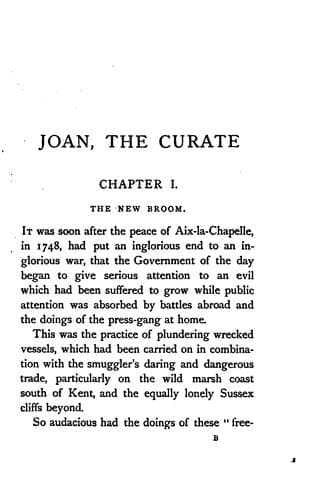
So audacious had the doings of these “free-traders” become, that a
brigade of cavalry was sent down into the old town of Rye, for the
purpose of overawing them, while, at the same time, a smart revenue
cutter, under the command of a young lieutenant of noted courage and
efficiency, was despatched to cruise about the coast, to act in concert
with the soldiers.
It was on a windy night in early autumn, when the sea was roaring
sullenly as it dashed against the sandstone cliffs, and echoed in the
caves and hollows worn by the waves, that a sharp knocking at the door
of Hurst Parsonage, a mile or two from the sea-coast, made Parson
Langney look up from the writing of his Sunday sermon, and glance
inquiringly at his daughter.
“Now, who will that be, Joan?” said he as he tilted his wig on to one
side of his head, and pursed up his jolly, round, red face with an air
of some anxiety.
“Nay, father, you have as many visitors that come for the ills of
the body as for the health of the soul!” cried Joan. “I can but hope
you han’t another long trudge across the marsh before you, like your
journey of a week back.”
At that moment there came another thundering knock at the little front
door, and a handful of stones and earth was flung against the window,
followed the next moment by a rattling of the panes.
Father and daughter, genial, portly parson, and creamy-skinned,
black-eyed maiden, sprang to their feet, and looked once at each other.
There were wild folk in these parts, and lonesome errands to be run
sometimes by Parson Langney, who had begun life as a surgeon, and who
had been lucky enough to be pitch-forked into a living which exactly
suited his adventurous habits, his love of fox-hunting, and his liking
for good wine and well-hung game.
Before the importunate summons could be repeated, Parson Langney had
come out of the little dining-parlor, and drawn the bolt of the front
door.
For Nance, the solitary housemaid of the modest establishment, was
getting into years, and inclined to regard a late visitor as a person
to be thwarted by being kept as long as possible waiting at the door.
“Hast no better manners than to do thy best to drive the glass from out
the panes?” asked he, as soon as he found himself face to face with
the intruder, who proved to be a sailor, in open jacket, loose shirt
and slops, and flat, three-cornered hat.
Public-domain text, read in full here on John Shaqi.
Reviews
Reviews
No reviews yet
Be the first to share your thoughts on this work.
Join the Discussion
Join the discussion
Sign in to leave a comment or review.
Sign InorCreate an account