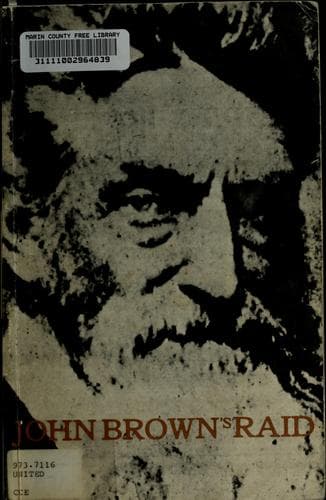
John Brown's RaidUnited States. National Park Service
History
John Brown's Raid
United States. National Park Service
Brown, John, 1800-1859; Harpers Ferry (W. Va.) -- History -- John Brown's Raid, 1859
As September ended and the time for the attack approached, Annie and
Martha were sent back to North Elba. Brown and his men busied themselves
overhauling the rifles and pistols and attaching pike-heads to shafts.
The pikes were Brown’s own idea. Preparing for a return to Kansas in
1857, he had negotiated with a Connecticut blacksmith to manufacture
1,000 of these weapons—a two-edged dirk with an iron blade 8 inches long
fastened to a 6-foot ash handle. Originally they were intended for the
defense of free-soil settlers in Kansas, but Brown was unable to pay for
them until the spring of 1859, when he made final arrangements to use
them at Harpers Ferry. Knowing that most of the slaves he expected to
join him were unskilled in the use of firearms, he decided they could
handle a pike. A thousand men armed with pikes and backed by Brown’s
more experienced “soldiers” could constitute a formidable army.
Because so many people knew about Brown’s intentions, it was inevitable
that the secrecy would be broken. In late August Secretary of War John
B. Floyd received an unsigned letter reporting “the existence of a
secret association, having for its object the liberation of the slaves
at the South by a general insurrection.” Brown was named as its leader
and “an armory in Maryland” its immediate objective. Because the
informant mistakenly placed the armory in Maryland instead of Virginia
and because Floyd could not bring himself to believe such a scheme could
be entertained by citizens of the United States, the Secretary put the
letter away and forgot about it until subsequent events reminded him of
the warning.
October arrived. Still Brown delayed, hoping that more men would come.
Many upon whom he had counted failed to join him for a variety of
reasons. Even two of his sons, Jason and Salmon, refused to participate.
Though disappointed, Brown realized that the longer he delayed, the
greater were the chances that his plan would be discovered and thwarted.
Finally, on October 15, with the arrival of 22-year-old Francis J.
Meriam and two Ohio Negroes, John Copeland and Lewis S. Leary, both 25,
the ranks of the “Provisional Army of the United States” were completed.
In all there were 21 men besides the commander in chief. Of these, 19
were under 30, three not yet 21. Brown could wait no longer. Calling his
men together, he announced that the attack would take place the next
night, October 16, and cautioned them about the needless taking of human
life:
You all know how dear life is to you ... consider that the lives of
others are as dear to them as yours are to you; do not, therefore,
take the life of anyone if you can possibly avoid it, but if it is
necessary to take life in order to save your own, then make short work
of it.
TO FREE THE SLAVES
Public-domain text, read in full here on John Shaqi.
Reviews
Reviews
No reviews yet
Be the first to share your thoughts on this work.
Join the Discussion
Join the discussion
Sign in to leave a comment or review.
Sign InorCreate an account