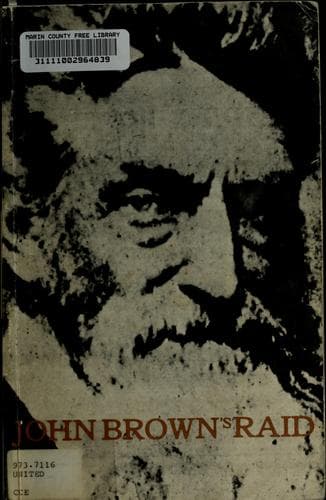
John Brown's RaidUnited States. National Park Service
History
John Brown's Raid
United States. National Park Service
Brown, John, 1800-1859; Harpers Ferry (W. Va.) -- History -- John Brown's Raid, 1859
As night approached, the firing sputtered out. Brown, knowing escape was
impossible, again attempted to bargain for freedom. In verbal and
written pleas he offered to release his hostages if he and his men were
allowed to leave unmolested. Col. Robert W. Taylor, now commanding the
Virginia militia units at Harpers Ferry, rejected the offers, sending
back word that if the prisoners were immediately released he would let
the Government deal with Brown and his men. But the old abolitionist
would not yield, and prisoners, slaves, and raiders alike settled down,
as best they could, to what would be a long and depressing night.
Brown paced up and down like a caged tiger. It had been hours since he
or any of them had tasted food or drink. The cold night air chilled
their bones and the pungent odor of gunpowder stung their nostrils. The
large-scale slave support that he had counted upon and for which the
pikes were intended had not materialized. This was largely his own
doing, however, for in his desire for absolute secrecy he had given no
advance word that he was coming. The slaves had no idea that a raid was
in progress. The few his men had picked up at the Washington and
Allstadt farms were of no use to him. They were frightened and preferred
to remain with the white hostages rather than take an active part in
their own salvation. Most likely they would not have joined him at all
had they not been taken from their homes at gunpoint.
From time to time Brown called out, “Men, are you awake?” Only five of
the raiders were still unwounded and able to hold a rifle: Brown
himself, Edwin Coppoc, J. G. Anderson, Dauphin Thompson, and Shields
Green. Stewart Taylor, the Canadian soldier of fortune, lay dead in a
corner, his presentiment of death come true. He had been shot like
Oliver Brown while standing at the enginehouse doorway. Oliver himself,
writhing in pain, begged to be killed and put out of his misery. “If you
must die, then die like a man,” snapped his father. After awhile Oliver
was quiet. “I guess he is dead,” Brown said. Nearby, Watson Brown lay
quietly breathing his last. The attack that had begun but 24 hours
before was fast coming to an end.
THE TRAP IS SPRUNG
The somberness that permeated the fire enginehouse contrasted sharply
with the din outside. Hundreds of militiamen and townspeople jammed the
streets, which echoed with whoops and yells. Anxious and hysterical
friends and relatives of Brown’s hostages added to the confusion. While
the quasi-military operations ended at nightfall, the non-military
activities continued with increasing fervor. The bars in the Wager House
and Gault House Saloon were enjoying an unprecedented business. Many men
were intoxicated, and they fired their guns wildly into the air and
occasionally at the enginehouse. All semblance of order was gone and the
“wildest excitement” prevailed throughout the night.
[Illustration: Albert Hazlett]
Public-domain text, read in full here on John Shaqi.
Reviews
Reviews
No reviews yet
Be the first to share your thoughts on this work.
Join the Discussion
Join the discussion
Sign in to leave a comment or review.
Sign InorCreate an account