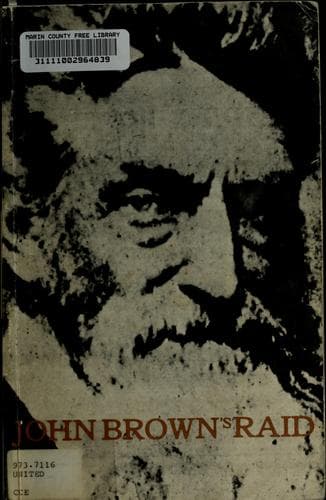
John Brown's RaidUnited States. National Park Service
History
John Brown's Raid
United States. National Park Service
Brown, John, 1800-1859; Harpers Ferry (W. Va.) -- History -- John Brown's Raid, 1859
At Frederick Junction I received a dispatch from Colonel Robert E. Lee,
who turned out to be the army officer to whom I was to report. He
directed me to proceed to Sandy Hook, a small place about a mile this
side of the Ferry, and there await his arrival. At ten o’clock in the
evening he came up on a special train from Washington. His first order
was to form the marines out of the car, and march from the bridge to
Harper’s Ferry. This we did, entering the enclosure of the arsenal
grounds through a back gate. At eleven o’clock Colonel Lee ordered the
volunteers to march out of the grounds, and gave the control inside to
the marines, with instructions to see that none of the insurgents
escaped during the night. There had been hard fighting all the preceding
day, and Brown and his men kept quiet during the night. At half-past six
in the morning Colonel Lee gave me orders to select a detail of twelve
men for a storming party, and place them near the engine-house in which
Brown and his men had intrenched themselves. I selected twelve of my
best men, and a second twelve to be employed as a reserve. The
engine-house was a strong stone [actually brick] building, which is
still in a good state of preservation at the Ferry, in spite of the
three days’ fighting in the building by Brown and his men, and the
ravages of the recent war between the States. The building was ...
perhaps thirty feet by thirty-five. In the front were two large double
doors, between which was a stone abutment. Within were two
old-fashioned, heavy fire-engines, with a hose-cart and reel standing
between them, and just back of the abutment between the doors. They were
double-battened doors, very strongly made, with heavy wrought-iron
nails. Lieutenant J. E. B. Stewart [Stuart], afterwards famous as a
cavalry commander on the side of the South, accompanied Colonel Lee as a
volunteer aid. He was ordered to go with a part of the troops to the
front of the engine-house and demand the surrender of the insurgent
party. Colonel Lee directed him to offer protection to Brown and his
men, but to receive no counter-proposition from Brown in regard to the
surrender. On the way to the engine-house, Stewart and myself agreed
upon a signal for attack in the event that Brown should refuse to
surrender. It was simply that Lieutenant Stewart would wave his hat,
which was then, I believe, one very similar to the famous chapeau which
he wore throughout the war. I had my storming party ranged alongside of
the engine-house, and a number of men were provided with sledge-hammers
with which to batter in the doors. I stood in front of the abutment
between the doors. Stewart hailed Brown and called for his surrender,
but Brown at once began to make a proposition that he and his men should
be allowed to come out of the engine-house and be given the length of
the bridge start, so that they might escape. Suddenly Lieutenant Stewart
waved his hat, and I gave the order to my men to batter in the door.
Public-domain text, read in full here on John Shaqi.
Reviews
Reviews
No reviews yet
Be the first to share your thoughts on this work.
Join the Discussion
Join the discussion
Sign in to leave a comment or review.
Sign InorCreate an account