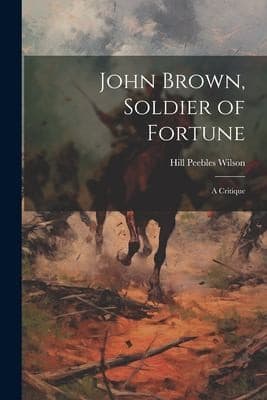
John Brown, Soldier of Fortune: A CritiqueWilson, Hill Peebles
History
John Brown, Soldier of Fortune: A Critique
Wilson, Hill Peebles
Brown, John, 1800-1859
John Brown
Soldier of Fortune
A Critique
[Illustration: John Brown]
JOHN BROWN
SOLDIER OF FORTUNE
_A Critique_
BY
HILL PEEBLES WILSON
[Illustration]
_Mr. Vallandigham_: Mr. Brown, who sent you here?
_John Brown_: No man sent me here; it was my own prompting
and that of my Maker, or that of the Devil, whichever you
please to ascribe it to. I acknowledge no master in human
form.
_Post, 313_
THE CORNHILL COMPANY
BOSTON
Copyright, 1913
HILL PEEBLES WILSON
Copyright, 1918
THE CORNHILL COMPANY
TO THE MEMORY OF
MRS. SARA T. D. ROBINSON
OF KANSAS
PREFACE
The writer of this book is not an iconoclast, neither has he prejudged
John Brown. In 1859 the character was impressed upon his attention in a
personal way. An older brother, Joseph E. Wilson, was a member of the
company of marines that made the assault on the engine-house at Harper's
Ferry, on the morning of October 18th; and from him he heard the story
of the fight, and about Brown.
In 1889 the Topeka (Kansas) _Daily Capital_ took a poll of the members
of the Kansas Legislature on the question: "Who was the most
distinguished Kansan?" or something to that effect. At that time the
writer held the opinion that the public services rendered by John Brown
in Kansas Territory, were of paramount importance in the settlement of
the Free-State contention; and since the course which the nation was at
that time pursuing had been arrested by the result of that contention,
and diverted into the path which led to the marvelous achievements of
the succeeding years; he, therefore, over his signature cast his vote in
favor of John Brown; saying, among other things, in his little
panegyric, that Brown is the only Kansan whose fame was immortal.
In 1898 he reformed his opinions concerning Brown's character and
conduct, and the importance of his public services in Kansas. The change
came about through an effort on his part to write a sketch of his life
for a work entitled "Eminent Men of Kansas." In good faith, and with
much of the confidence and enthusiasm characteristic of Brown's
eulogists, he began an investigation of the available historical data
relating to the subject; when he found to his surprise, and disgust,
that the history of Brown's career contained nothing to justify the
public estimate of him.
Reporting to his associate that he would not write the sketch, he said
that he "could find but little in the record of his life which gave him
creditable distinction, and that he did not wish to write the
discreditable things about him which it contained."
Public-domain text, read in full here on John Shaqi.
Reviews
Reviews
No reviews yet
Be the first to share your thoughts on this work.
Join the Discussion
Join the discussion
Sign in to leave a comment or review.
Sign InorCreate an account