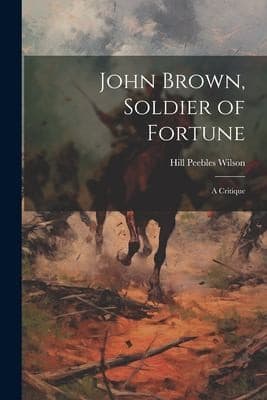
John Brown, Soldier of Fortune: A Critique — John Shaqi
John Brown, Soldier of Fortune: A CritiqueWilson, Hill Peebles
History
John Brown, Soldier of Fortune: A Critique
Wilson, Hill Peebles
Brown, John, 1800-1859
Brown's younger sons were infidels. They had "discovered the Bible to be
all fiction."[44] To the Sabbath day and its sanctity, he was
indifferent. In violation of the stricter conventions, which prevailed
at that time, concerning the observance of it as "Holy unto the Lord,"
he committed the principal crimes incident to his career, wholly or in
part, on the Sabbath. A part of the murders and thefts on the
Pottawatomie were committed on Sunday morning, May 25, 1856. Returning
to Kansas from Nebraska City (August 9th and 10th) half the journey was
made on Sunday, August 10th. "On August 24," 1856 (Sunday), "the Brown
and Cline companies set out for the South, marching eight miles and
camping on Sugar Creek."[45] Sunday night, October 16, 1859, was the
time fixed for the insurrection of the slaves to occur, and on that
night, in pursuance of his plans, he occupied Harper's Ferry.
Brown was averse to military operations, and military affairs. He
refused to drill with the local militia, paying the fines instead, which
were imposed by law for such delinquencies. In political matters he
affiliated with the Abolitionists, or with those of the party who were
"non-resistants."[46]
The statements which have been put forth in support of the assumption
that Brown's life was a devotion to the Anti-Slavery cause--a series of
abnormal activities in opposition to slavery--are not confirmed, nor can
they be justified by any contemporaneous evidence. For notwithstanding
the persistent, if not offensive, insistence of his biographers to the
contrary; and the pages without number which have been written in
support of such insistence, the record of his life is practically
barren in relation to the subject. There is not a scrap of concurrent
evidence which, even remotely, suggests that prior to 1855 he might have
taken more than a most ordinary interest in securing freedom for the
slaves. Even in his letter of that year to Mr. John W. Cook (_note_ 40),
informing him of his intention to go to Kansas, and of his motive for
going thereto, he made no reference to the subject whatever. A statement
of everything which Brown did, or that he attempted to do up to that
year, in opposition to slavery, may be republished in this book without
encumbering its pages. It will therefore be given.
Public-domain text, read in full here on John Shaqi.
Reviews
Reviews
No reviews yet
Be the first to share your thoughts on this work.
Join the Discussion
Join the discussion
Sign in to leave a comment or review.
Sign InorCreate an account