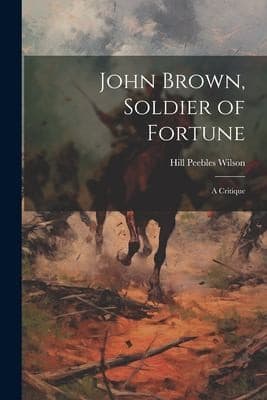
John Brown, Soldier of Fortune: A CritiqueWilson, Hill Peebles
History
John Brown, Soldier of Fortune: A Critique
Wilson, Hill Peebles
Brown, John, 1800-1859
Such was the man--of the best New England blood, of the
stock of the Plymouth Pilgrims, and bred up like them "in
the nurture and admonition of the Lord"--who was selected
by God, and knew himself to be so chosen, to overthrow the
bulwark of oppression in America. He seems to have declared
a definite plan of attacking slavery in one of its
strongholds, by force, as early as 1839; and it was to
obtain money for this enterprise that he engaged in
land-speculations and wool-merchandise for the next ten or
twelve years.... Other men might have been spared but Brown
was indispensable.[496]
Said Wendell Phillips:
God makes him the text, and all he asks of our
comparatively cowardly lips is to preach the sermon, and
say to the American people that, whether this old man
succeeded in a worldly sense or not, he stood as a
representative of law, of government, of right, of justice,
of religion, and they were pirates that gathered about him,
and sought to wreak vengeance by taking his life. The banks
of the Potomac are doubly dear now to History and to Man!
The dust of Washington rests there; and History will see
forever on that river side the brave old man on his pallet,
whose dust, when God calls him hence, the Father of his
Country would be proud to make room for beside his own.
Mr. Higginson said:
Such men as he needed are not to be _found_ ordinarily;
they must be _reared_. John Brown did not merely look for
men, therefore, he reared them in his sons.
John A. Andrew, who did not believe that Brown was present or in any way
connected with the robberies and murders on the Pottawatomie, said:
Whatever may be thought of John Brown's acts, _John Brown
himself was right_.
The Rev. Theodore Parker, who believed in slave insurrections and their
horrors, wrote:
Let the American State hang his body and the American
Church damn his soul. Still, the blessing of such as are
ready to perish will fall on him, and the universal justice
of the Infinitely Perfect God will make him welcome home.
The road to heaven is as short from the gallows as from the
throne.
Mr. Emerson said:
That new saint, than whom none purer or more brave was ever
led by love of men into conflict and death--the new saint
awaiting his martyrdom, and who, if he shall suffer, will
make the gallows glorious like the cross.
Into a carnival of rhetoric so picturesque, Mr. John James Ingalls could
not fail to enter the lists and compete for the prize. Poising his
shining lance he delivered this thrust:
Public-domain text, read in full here on John Shaqi.
Reviews
Reviews
No reviews yet
Be the first to share your thoughts on this work.
Elsewhere in the archive
Join the Discussion
Join the discussion
Sign in to leave a comment or review.
Sign InorCreate an account