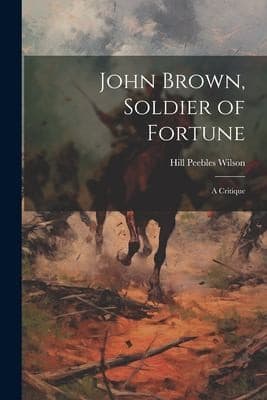
John Brown, Soldier of Fortune: A CritiqueWilson, Hill Peebles
History
John Brown, Soldier of Fortune: A Critique
Wilson, Hill Peebles
Brown, John, 1800-1859
But the three men of this era who will loom forever against
the remotest horizon of time, as the pyramids above the
voiceless desert, or the mountain peaks above the
subordinate plains, are Abraham Lincoln, Ulysses S. Grant
and Old John Brown of Osawatomie.
Victor Hugo said:
The punishment of John Brown may consolidate slavery in
Virginia, but it will certainly shatter the American
Democracy. You preserve your shame but you kill your glory.
Similar exhibits, in the hyperbolical optimism that constitutes this
promotion by wind, might be added hereto indefinitely; for the output of
such fantastical flights was limited only by the boundaries of taste and
imagination. Probably the best things have been said. But that does not
wholly discourage the later generations. Emulation in the phrase making
competition still places a premium upon inconsistency. Mr. Villard said
fifty years after:
In Virginia, John Brown atoned for Pottawatomie by the
nobility of his philosophy and his sublime devotion to
principle, even on the gallows.
Perhaps nowhere else than in the peculiar philosophy of those who
attribute virtue to Brown as a motive for vice, may we find nobility in
dissimulation; atonement without reconciliation; and the sublimity of
devotion to principle in the denial of the truth. Awaiting death in the
Charlestown jail, Brown denied that he had been a party to the murders
and the robberies on the Pottawatomie; and went from the gallows into
the presence of the Almighty to answer for both his participation in
that horror and for his repeated denials of having been personally
concerned in it.[497]
December 10, 1911, Mr. Clyde McGee, of Chicago, said, among many other
worked-over things:
It grew upon him as he prayed, for John Brown was a man
who talked with God as confidently as a friend speaketh
with friend.[498]
When Brown and his sons planned, during March and April and May, 1856,
to steal Doyle's, and Wilkinson's, and other settlers' horses and leave
the country; they planned, as a precautionary measure, to first make
widows and orphans of the wives and children of these men, and then to
steal the horses; not from the dead men, but from the weeping women and
helpless children. Who think you talked with Brown and his swaggering
sons as "friend speaketh with friend" during the time their plans were
being made for these assassinations and robberies, and while they
executed them: The Almighty, or the Devil? Brown was not sure who it was
that prompted him to incite the slaves to strike for their liberty, by
assassinating their masters. He answered Mr. Vallandigham at Harper's
Ferry:
No man sent me here; it was my own prompting and that of my
Maker, or that of the Devil; whichever you please to
ascribe it to. I acknowledge no master in human form.[499]
Public-domain text, read in full here on John Shaqi.
Reviews
Reviews
No reviews yet
Be the first to share your thoughts on this work.
Elsewhere in the archive
Join the Discussion
Join the discussion
Sign in to leave a comment or review.
Sign InorCreate an account