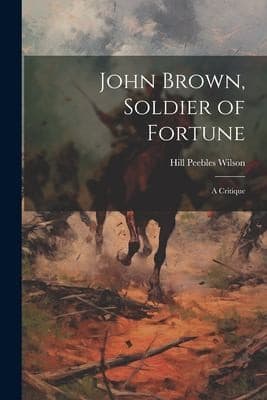
John Brown, Soldier of Fortune: A CritiqueWilson, Hill Peebles
History
John Brown, Soldier of Fortune: A Critique
Wilson, Hill Peebles
Brown, John, 1800-1859
Of Brown, it may be truthfully said that within the limits of his
resources, he did nothing in a small way, nor did he move with a faint
heart. With him, there was neither halting nor trifling in action. He
was consistently an adventurer. His theology scorned all creeds. Without
capital he was a plunger among speculators. The deception which he
practiced upon the New England Woolen Company netted him a fortune
little below the average of that period. In the commission business he
was an acrobat, rather than a merchant: his operations were a series of
feats in commercial gymnastics. Chafing because of the restrictions of
an extreme poverty that kept him "like a toad under a harrow," he
determined to burst the bands of his environment, and there was a
massacre in the valley of the Pottawatomie out of which he rode with a
herd of horses. And he would have ridden away from Black Jack with
Pate's horses and mules, if Pate had not deceived him, and led him to
believe that he held his sons--John and Jason--prisoners, as hostages. A
guerrilla leader for six days, he drove two hundred and fifty head of
cattle into his camp at Osawatomie, and in 1858, as a Kansas raider, he
dwarfed the operations of James Montgomery. In the East, as a crafty
imposter and grafter, he secured $30,000 in cash and plunder, and
attempted a _coup_ upon the Legislatures of Massachusetts and New York
for $200,000 more. And then, within one year from the date of the
outburst of his determination to be freed from poverty, he indulged
hopes of a successful conquest: hopes of riches and of fame. An habitual
cruelty in his domestic life, which is more than hinted at by his
friend and confidant, George R. Gill, nerved his hand to execute the
ferocious butchery of his neighbors on the Pottawatomie, and steeled his
heart to incite the slaves at Harper's Ferry to emulate the example of
Southampton. His attempt at revolution was not the result of a previous
conviction and consecration to duty and to the cause of humanity, but of
a growth--the indulgence and development of an abnormal passion for
speculation: the culmination downward of his speculative and criminal
instincts. Closing a commercial sas indulging the reasonable hope that
in the new country he would find opportunity to improve his condition.
In the horses owned by the Shermans, and by other well-to-do neighbors,
he saw, and grasped, the opportunity--a desperate one--to make a "coup
to restore his fortunes." Out of that plunge in robbery and murder came
the leader of a gang of horse thieves--the chrysalis of the guerrilla
captain of Osawatomie.
Public-domain text, read in full here on John Shaqi.
Reviews
Reviews
No reviews yet
Be the first to share your thoughts on this work.
Elsewhere in the archive
Join the Discussion
Join the discussion
Sign in to leave a comment or review.
Sign InorCreate an account