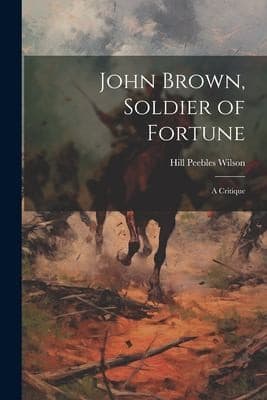
John Brown, Soldier of Fortune: A Critique — John Shaqi
John Brown, Soldier of Fortune: A CritiqueWilson, Hill Peebles
History
John Brown, Soldier of Fortune: A Critique
Wilson, Hill Peebles
Brown, John, 1800-1859
DEAR WIFE ... Since the sending off to slavery of Long from
New York, I have improved my leisure hours quite busily
with colored people here, in advising them how to act, and
in giving them all the encouragement in my power. They very
much need encouragement and advice; and some of them are so
alarmed that they tell me they cannot sleep on account of
either themselves or their wives and children. I can only
say I think I have been enabled to do something to revive
their broken spirits. I want all my family to imagine
themselves in the same dreadful condition. My only spare
time being taken up (often until late hours at night) in
the way I speak of, have prevented me from the gloomy
homesick feelings which had before so much oppressed me:
not that I forget my family at all.
The assumption that Brown, "The peaceful tanner and shepherd," had at
this time been transformed "into a man burning to use arms upon an
institution which refused to yield to peaceful agitation,"[56] is not
justified by anything that he had theretofore said or done relating to
slavery; neither is it justified by what he wrote to the "Gileadites,"
nor by the letter which he wrote to his wife concerning the condition of
the free negroes. These papers contain no hint, to say nothing of
evidence, that the action taken therein by him was the result of any
preconceived intention to attack slavery; or that it was related to any
general plan or purpose to oppose slavery; or that it foreshadowed any
disposition on his part, burning or otherwise, to engage in the matter
any further than by counsel and advice. The letter to his wife reflects
the general sense of compassion that was felt for the negroes, by all
humane people throughout the North, because of the distressful condition
in which they were placed by the terms of the Fugitive Slave Law.
The foregoing is a recital of all that is contained in the record of
Brown's life concerning his anti-slavery activities up to the year 1852.
In the working of that great engine for emancipation, the Underground
Railway, he took no part. Of the more than seventy-five thousand slaves
who were carried from bondage to freedom by the self-sacrificing
agencies of the system, Brown, it is said, gave shelter and a meal to
but one of them. The late Colonel Thomas Wentworth Higginson, militant
clergyman and abolitionist, in a eulogy upon Brown, said:[57]
Public-domain text, read in full here on John Shaqi.
Reviews
Reviews
No reviews yet
Be the first to share your thoughts on this work.
Join the Discussion
Join the discussion
Sign in to leave a comment or review.
Sign InorCreate an account