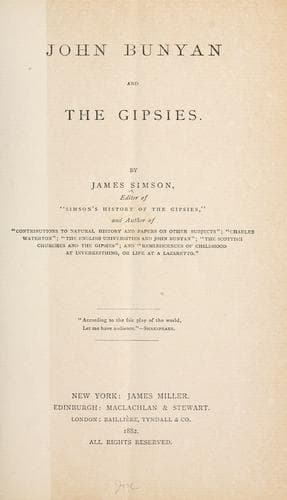
Bunyan, John, 1628-1688 -- Relations with Romanies; Leland, Charles Godfrey, 1824-1903; Romanies
{19a} One of Mr. Leland’s “confident assertions” is that “the English
Gipsy cares not a farthing ‘to know anything about his race as it exists
in foreign countries, or whence it came’”; which is not a fact. He seems
to have misinterpreted the _English Gipsy_ peculiarity which assimilates
_in appearance_ to the _native English_ one, as I have written thus in
the _History of the Gipsies_:—“Though Gipsies everywhere, they differ in
some respects in the various countries which they inhabit. For example,
an English Gipsy of pugilistic tendencies will, in a vapouring way,
engage to _thrash_ a dozen of his Hungarian brethren” (p. 359). And of
the more mixed kind of Gipsies, I have said:—“In Great Britain the
Gipsies are entitled, in one respect at least, to be called Englishmen,
Scotchmen, or Irishmen; for their general ideas as men, as distinguished
from their being Gipsies, and their language indicate them at once to be
such, nearly as much as the common natives of these countries” (p.
372).—What is described very fully throughout the _History_, and
especially in the note at pp. 342 and 343, about the different colours or
castes of the Gipsies, meets Mr. Leland’s remarks about those who left
India. Thus:—“What are full-blood Gipsies, to commence with? The idea
itself is intangible; for, by adopting, more or less, wherever they have
been, others into their body, during their singular history, a pure
Gipsy, like the pure Gipsy language, is doubtless nowhere to be found”
(p. 342).
{19b} With the limited space at his disposal for his cyclopædia article,
Mr. Leland could not be expected to tell us much in it about the Gipsies.
In it he says that “their hair seldom turns gray, even in advanced age,
unless there be ‘white’ blood in their veins”; that, “like North American
Indians, the Gipsies all walk with their feet straight”; and that “there
are nearly 100 English Gipsy family names, most of which are represented
in America.” And further:—“At the present day the Romany is the life of
the entire vagabond population of the roads in England, it being almost
impossible to find a tinker or petty hawker who is not part Gipsy. There
are now but a few hundred full-blooded _tent_ Gipsy persons in England
(1874), but of . . . house-dwellers, who keep their Gipsy blood a secret,
and of half-breeds . . . or of those affiliated by blood, all of whom
possess the great secret of the Romany language to a greater or less
degree, there are perhaps 20,000.” “The tinkers in England are all
Gipsies.”
Including _all_ of “the blood” in _various_ positions in life, there are
doubtless _vastly_ more of the tribe in England than 20,000, considering
the time they have been in the country, and the healthy and prolific
nature of the race.
{21} The same remark applies to _The English Gipsies and their
Language_.
Public-domain text, read in full here on John Shaqi.
Reviews
Reviews
No reviews yet
Be the first to share your thoughts on this work.
Join the Discussion
Join the discussion
Sign in to leave a comment or review.
Sign InorCreate an account