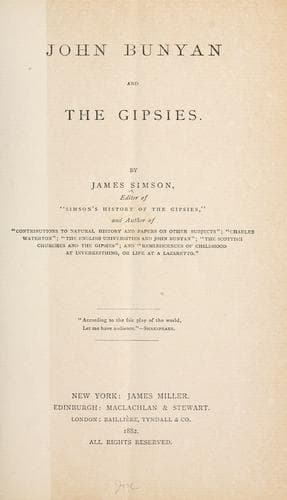
Bunyan, John, 1628-1688 -- Relations with Romanies; Leland, Charles Godfrey, 1824-1903; Romanies
If some highly educated men have missed the hinge on which the Gipsy
question turns—that the race perpetuates itself in a settled condition,
irrespective of character and other circumstances—and have had a
difficulty in realizing it in all its bearings, we can easily excuse the
congregation of Bunyan’s church for holding views similar to those of the
community at large, on a subject that is more or less complex in its
nature. But they can never expect to do justice to it unless they
approach it with every desire to do what is proper, and not with the
rooted aversion with which it has hitherto been regarded. What Bunyan
told us of himself and family he said was “well known to many”; and he
seems to have assumed that it was, or would have been, understood by the
world. I have even suggested that he had been more precise with some of
his friends, who might (as they very probably would) have suppressed what
he told them in regard to the nationality of himself and his “father’s
house.” If he had publicly said plainly that he was of the Gipsy race,
that would have been a _fact_, which required no _proof_. But there was
no necessity or occasion for him to have said what he did.
It appeals to every principle of fair play and abstract reason that a
race that has been in Great Britain for 375 years must be considered in
many respects British, whatever its origin, or whatever the habits of
some of it may be. It would be very wrong to show and perpetuate a
prejudice against the name, or blood as such, however little or however
much there may be of it in the person possessing and claiming it.
Everything else being equal, such a man, instead of having a prejudice
entertained for him, is entitled to a greater respect than should be
shown to another who labours under no such prejudice in regard to his
blood. Apply this principle to Bunyan and he will stand higher than he
has done. He was evidently a man that was “chosen of God” to shine
brilliantly among the children of a common parent; and it becomes all of
us to acknowledge him. It is to be hoped that the congregation of the
church of which he was the honoured pastor will approach this subject at
least with wariness, and not, against all evidence, reject him who was a
divine instrument for the benefit of humanity, in its highest
concernment; merely because he was a member of a particular “family in
the land,” which has never yet been acknowledged in any shape or form,
however numerous it is.
MR. LELAND ON THE GIPSIES. {11a}
I.
THE _History of the Gipsies_, by Walter Simson, which I edited and
published in 1865, was ready for the press in 1858. In a prefatory note
to it I said:—
“In the present work the race has been treated of so fully and
elaborately, in all its aspects, as in a great measure to fill and
satisfy the mind, instead of being, as heretofore, little better than
a myth to the understanding of the most intelligent person.”
Public-domain text, read in full here on John Shaqi.
Reviews
Reviews
No reviews yet
Be the first to share your thoughts on this work.
Join the Discussion
Join the discussion
Sign in to leave a comment or review.
Sign InorCreate an account