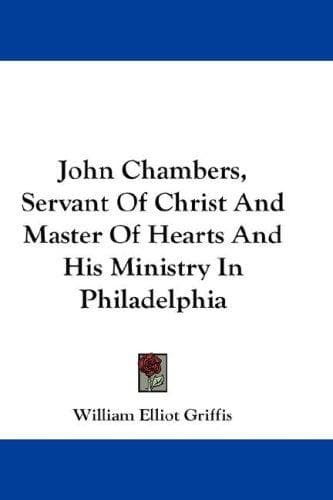
John Chambers, Servant of Christ and Master of Hearts, and His Ministry in PhiladelphiaGriffis, William Elliot
Religion
John Chambers, Servant of Christ and Master of Hearts, and His Ministry in Philadelphia
Griffis, William Elliot
Chambers, John, 1797-1875
In pursuance of his plan, the lad entered the Classical Academy of the
Rev. James Gray, D.D., formerly of Philadelphia, who had established
in Baltimore one of the numerous first-class schools in the South,
almost every one of which was founded by people of Scotch-Irish
descent. When it came to the study of theology and practical training
for the pastorate, John Chambers followed the method which was then
the common one in America. Very few theological seminaries then
existed in the country. That at New Brunswick, N. J., probably the
oldest, was scarcely fifteen years of age; that at Princeton hardly
over two years old. There were one or two in New England. For a young
man having the ministry in view, it was the usual custom to study
under his own pastor, a method not without great benefits, especially
in this instance, as Dr. Duncan was one of the most eloquent ministers
in the country. John Chambers learned how to preach by preaching. He
was successful with human beings because he knew them so well. He
was a master of the scriptures "in the original English". Only those
who afterward sat for years under John Chambers' preaching so long as
to be saturated with his ideas, to know the basic principles of his
thought and the workings of his mind, and have also read and studied
Dr. Duncan's works, can realize how greatly the pupil was indebted to
his great master.
In fact it was John Mason Duncan who gave the keynote of the gospel
message as to its form, and it was John Chambers who filled out
the strain. The theme was set in Baltimore, the variations given
in Philadelphia. The pupil followed the master very closely in
practical organization and discipline also. Dr. Duncan was suspicious
of all creeds and confessions of faith when made instruments of
ecclesiastical power. His trust in the people was sincere, profound,
intense, and practical. In theology he ever laid stress on "the
mediatorial reign of Christ and his absolute ability and willingness
to save all mankind", which willingness it was his delight to
demonstrate from the Scriptures and "to rescue the Gospel call from
false philosophy". Dr. Duncan was jealous, almost to hostility, of
theological seminaries, and also of the growing usurpations of power
by synods. He dubbed America "the land of synods". He wrote at the
time when even the liberty of the presbyteries seemed endangered by
the centralizing power of the synods: "To persevere in such a course
is to raise up a class of men who, from the nature of the case, must
be destitute of sympathy with the people; who will rise above the
people as being their superiors and governors, and who will ultimately
distract and divide the church by their philosophic subtleties and
literary distinction".
Verily the writer of those words was a prophet.
Dr. Duncan's trust in the people was so great because, as he believed
and taught, "the Bible is addressed to the people".
Public-domain text, read in full here on John Shaqi.
Reviews
Reviews
No reviews yet
Be the first to share your thoughts on this work.
Join the Discussion
Join the discussion
Sign in to leave a comment or review.
Sign InorCreate an account