Produced by Chris Curnow, Joseph Cooper, Louise Pattison
and the Online Distributed Proofreading Team at
http://www.pgdp.net
CONTRIBUTIONS FROM
THE MUSEUM OF HISTORY AND TECHNOLOGY:
PAPER 2
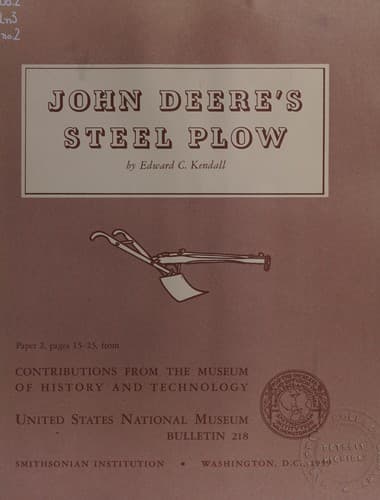
JOHN DEERE'S STEEL PLOW
_Edward C. Kendall_
DEERE AND ANDRUS 17
THE FIRST PLOW 19
STEEL OR IRON 21
WHY A STEEL PLOW 23
RECONSTRUCTIONS 24
IN SUMMARY-- 25
_By Edward C. Kendall_
JOHN DEERE'S STEEL PLOW
_John Deere in 1837 invented a plow that could be used
successfully in the sticky, root-filled soil of the prairie.
It was called a steel plow. Actually, it appears that only the
cutting edge, the share, on the first Deere plows was steel.
The moldboard was smoothly ground wrought iron._
_Deere's invention succeeded because, as the durable steel
share of the plow cut through the heavy earth, the sticky soil
could find no place to cling on its polished surfaces._
Americans moving westward in the beginning of the 19th century soon
encountered the prairie lands of what we now call the Middle West. The
dark fertile soils promised great rewards to the farmers settling in
these regions, but also posed certain problems. First was the breaking
of the tough prairie sod. The naturalist John Muir describes the
conditions facing prairie farmers when he was a boy in the early 1850's
as he tells of the use of the big prairie-breaking plows in the
following words:[1]
They were used only for the first ploughing, in breaking up
the wild sod woven into a tough mass, chiefly by the cord-like
roots of perennial grasses, reinforced by the tap roots of oak
and hickory bushes, called "grubs," some of which were more
than a century old and four or five inches in diameter.... If
in good trim, the plough cut through and turned over these
grubs as if the century-old wood were soft like the flesh of
carrots and turnips; but if not in good trim the grubs
promptly tossed the plough out of the ground.
Public-domain text, read in full here on John Shaqi.
Reviews
Reviews
No reviews yet
Be the first to share your thoughts on this work.
Join the Discussion
Join the discussion
Sign in to leave a comment or review.
Sign InorCreate an account