Produced by Adrian Mastronardi, Martin Pettit and the
Online Distributed Proofreading Team at http://www.pgdp.net
(This file was produced from images generously made
available by The Internet Archive/Canadian Libraries)
CORNELL STUDIES IN PHILOSOPHY
No. 11
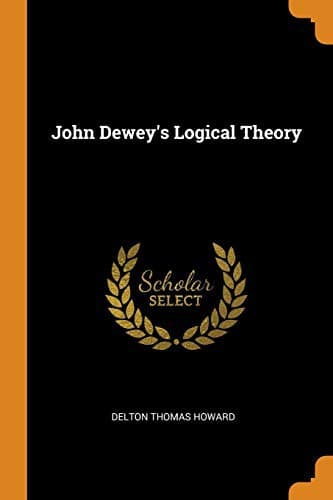
JOHN DEWEY'S LOGICAL THEORY
BY
DELTON THOMAS HOWARD, A.M.
FORMERLY FELLOW IN THE SAGE SCHOOL OF PHILOSOPHY
A THESIS
PRESENTED TO THE FACULTY OF THE GRADUATE SCHOOL OF
CORNELL UNIVERSITY IN PARTIAL FULFILMENT OF THE
REQUIREMENTS FOR THE DEGREE OF DOCTOR OF PHILOSOPHY
NEW YORK
LONGMANS, GREEN, & CO.
1919
PRESS OF
THE NEW ERA PRINTING COMPANY
LANCASTER, PA.
PREFACE
It seems unnecessary to offer an apology for an historical treatment of
Professor Dewey's logical theories, since functionalism glories in the
genetic method. To be sure, certain more extreme radicals are opposed to
a genetic interpretation of the history of human thought, but this is
inconsistent. At any rate, the historical method employed in the
following study may escape censure by reason of its simple character,
for it is little more than a critical review of Professor Dewey's
writings in their historical order, with no discussion of influences and
connections, and with little insistence upon rigid lines of development.
It is proposed to "follow the lead of the subject-matter" as far as
possible; to discover what topics interested Professor Dewey, how he
dealt with them, and what conclusions he arrived at. This plan has an
especial advantage when applied to a body of doctrine which, like
Professor Dewey's, does not possess a systematic form of its own, since
it avoids the distortion which a more rigid method would be apt to
produce.
It has not been possible, within the limits of the present study, to
take note of all of Professor Dewey's writings, and no reference has
been made to some which are of undoubted interest and importance. Among
these may be mentioned especially his books and papers on educational
topics and a number of his ethical writings. Attention has been devoted
almost exclusively to those writings which have some important bearing
upon his logical theory. The division into chapters is partly arbitrary,
although the periods indicated are quite clearly marked by the different
directions which Professor Dewey's interests took from time to time. It
will be seen that there is considerable chance for error in
distinguishing between the important and the unimportant, and in
selecting the essays which lie in the natural line of the author's
development. But, _valeat quantum_, as William James would say.
Public-domain text, read in full here on John Shaqi.
Reviews
Reviews
No reviews yet
Be the first to share your thoughts on this work.
Join the Discussion
Join the discussion
Sign in to leave a comment or review.
Sign InorCreate an account