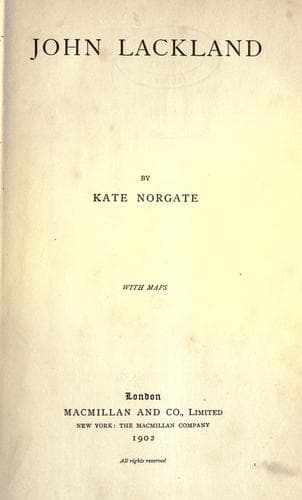
Great Britain -- History -- John, 1199-1216; Great Britain -- Kings and rulers -- Biography; John, King of England, 1167-1216
Henry and Richard had been set at strife by an illusion of their own
imaginations. Richard had been spurred to rebellion by the idea that
his father aimed at disinheriting him in favour of John, and might
succeed in that aim, unless prevented by force. Henry’s schemes for
John were probably in reality much less definite and less outrageous
than Richard imagined; but there can be little doubt that the otherwise
unaccountable inconsistencies and self-contradictions, the seemingly
wanton changes of front, by which the king in his latter years had
so bewildered and exasperated his elder son, were the outcome of an
insatiable desire to place John, somehow or other, in a more lofty and
independent position than a younger son was fairly entitled to expect.
The strange thing is that Henry never perceived how hopeless were his
efforts, nor Richard how groundless were his fears; neither of them,
apparently, realizing that the substitution of John for Richard as heir
of the Angevin house was an idea which could not possibly be carried
into effect. The utter selfishness of John, however, rendered him, mere
lad of one-and-twenty as he was, proof against illusions where his own
interest was concerned; and it was he who pricked the bubble. On July 4
Henry, sick unto death, made his submission to Philip and Richard, and
received a list of the traitors who had transferred their homage to the
latter. That night, at Chinon, he bade his vice-chancellor read him the
names. The vice-chancellor hesitated; the king insisted; at last the
truth which was to give him his death-blow came out: “Sire, the first
that is written down here is Lord John, your son.”[111]
FOOTNOTES:
[1] _I.e._ Henry II.
[2] The place comes from the prose addition to Robert of Gloucester,
ed. Hearne, vol. ii. p. 484; on the date see Stubbs, pref. to W.
Coventry, vol. ii. p. xvii.
[3] R. Torigni, a. 1155; Gerv. of Canterbury, vol. i. p. 162.
[4] R. Torigni, a. 1160.
[5] R. Diceto, vol. i. p. 306.
[6] _Ib._ p. 311.
[7] R. Torigni, a. 1159.
[8] R. Torigni, a. 1166.
[9] “Quartum natu minimum Johannem Sine Terra agnominans,” W. Newburgh,
l. ii. c. 18. Cf. W. Armor. _Philippis_, l. vi. vv. 591, 592, who says,
addressing John--
“Antea quam fato fieres ludente monarcha,
Patris ab ore tui Sine-Terra nomen habebas.”
The name seems to have been commonly used as if it were a part of
John’s proper designation: “Johannes ... quem vocant Sine Terra,
quamvis multas et latas habet possessiones et multos comitatus,”
says R. Torigni, a. 1185. So the writer of the _Estoire de la Guerre
Sainte_: “Johan sanz Terre ot nom li mendres,” v. 179; “Johan sanz
Terre, Por qui il ot tant noise e guere,” vv. 101, 102.
Public-domain text, read in full here on John Shaqi.
Reviews
Reviews
No reviews yet
Be the first to share your thoughts on this work.
Join the Discussion
Join the discussion
Sign in to leave a comment or review.
Sign InorCreate an account