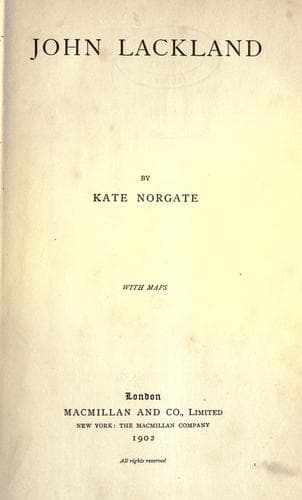
Great Britain -- History -- John, 1199-1216; Great Britain -- Kings and rulers -- Biography; John, King of England, 1167-1216
“The closer study of John’s history clears away the charges of sloth
and incapacity with which men tried to explain the greatness of his
fall. The awful lesson of his life rests on the fact that the king
who lost Normandy, became the vassal of the Pope, and perished in a
struggle of despair against English freedom was no weak and indolent
voluptuary but the ablest and most ruthless of the Angevins.”
JOHN RICHARD GREEN.
CHAPTER I
JOHN LACKLAND
1167–1189
.... Johan sanz Terre,
Por qui il[1] ot tant noise e guere.
_Estoire de la Guerre Sainte_, vv. 101, 102.
[Sidenote: 1167]
The fifth son, the eighth and last child, of Henry II. of England and
Eleanor of Aquitaine was born at Oxford, in the “King’s manor”--that
is, the palace of Beaumont--on Christmas Eve 1167.[2] Of their six
other surviving children, the three younger were daughters; the last of
these, Joanna, was then two years old. The eldest living son, Henry,
was nearly thirteen; Richard was ten, and Geoffrey nine. The boy Henry
had, when an infant, been acknowledged by the barons of England as
heir to the crown,[3] and in 1160 had done homage to Louis of France
for the duchy of Normandy.[4] In 1162 preparations had been made for
his crowning in England, and he had again received the homage of the
barons,[5] to which that of the Welsh princes and the Scot king was
added in 1163.[6] Eleanor’s duchy of Aquitaine had been destined for
her second surviving son, Richard, as early as 1159,[7] when he was
not yet two years old. In the summer of 1166 the king had secured
Britanny for Geoffrey by betrothing him to its heiress.[8] The whole
Angevin dominions, with one exception, were thus, in design at least,
partitioned among John’s brothers before John himself was born. The
exception was, indeed, an important one; in the contemporary accounts
of Henry’s plans during this period for the distribution of his
territories, there is no mention of Anjou and its dependency Touraine.
The reason, however, is obvious. Anjou was the cradle of his race, the
very heart and centre of his dominion, the one portion of it which he
had inherited from his forefathers in unbroken male descent, by a right
which had been always undisputed and indisputable. The destiny of Anjou
was therefore as yet unspecified, not because Henry was reserving it
for a possible younger son, but because its devolution to his eldest
son, as head of the Angevin house after him, was in his mind a matter
of course. It was in fact Henry himself who gave to his new-born child
the name which has clung to him ever since--“Johans Sanz Terre,” John
Lackland.[9]
[Sidenote: 1169]
Public-domain text, read in full here on John Shaqi.
Reviews
Reviews
No reviews yet
Be the first to share your thoughts on this work.
Join the Discussion
Join the discussion
Sign in to leave a comment or review.
Sign InorCreate an account