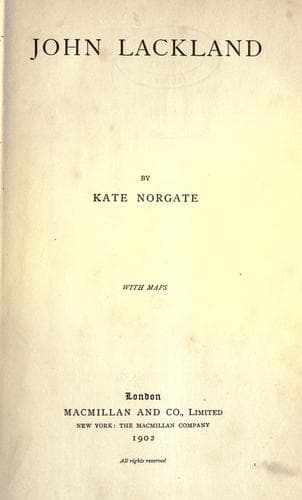
Great Britain -- History -- John, 1199-1216; Great Britain -- Kings and rulers -- Biography; John, King of England, 1167-1216
Of the way in which John was likely to use his new independence he
had already given a significant indication. Shortly after Richard’s
accession the wardship of the heiress of Leinster, Isabel de Clare, was
terminated by her marriage with William the Marshal.[130] Her great
Irish fief, as well as her English and Welsh lands, thus passed into
the hands of a man who was already one of the most trusted friends and
counsellors of Richard, as he had been of Henry, and whose brother
had once been seneschal to John himself.[131] No sooner had William
entered upon the heritage of his wife than John disseised him of a
portion of Leinster and parcelled it out among friends of his own.
The Marshal appealed to Richard; Richard insisted upon John’s making
restitution, and John, after some demur, was compelled to yield, but
not entirely; he managed to secure the ratification of a grant which he
had made to his butler, Theobald Walter, out of the Marshal’s lands,
although, by way of compromise, it was settled that Theobald should
hold the estate in question as an under-tenant of William, not as a
tenant-in-chief of John.[132] On the other hand, John did not at once
displace the governor whom his father had set over the Irish march
four years before, John de Courcy. He had no thought of undertaking
the personal government of his dominions in Ireland. To do so he must
have turned his back upon the opportunities which Richard’s misplaced
generosity was opening to him in England--opportunities of which it
was not difficult to foresee the effect upon such a mind as his. As
William of Newburgh says, “The enjoyment of a tetrarchy made him covet
a monarchy.”[133]
[Sidenote: 1190]
That Richard presently awoke to some consciousness of the danger which
he had created for himself and his realm maybe inferred from the fact
that in February 1190 he summoned John to Normandy, and there made
him swear not to set foot in England for the next three years. The
queen-mother, however, afterwards persuaded her elder son to release
the younger one from this oath;[134] or, according to another account,
to leave the decision of the matter to the justiciar and chancellor,
William of Longchamp, bishop of Ely. John was to visit the chancellor
in England, and either remain there or go into exile, as William might
choose.[135] It is clear, however, that William had no real choice. He
was legate in England, and therefore absolution from him was necessary
to protect John against the ecclesiastical consequences of a violated
oath; but as the violation was sanctioned by the king to whom the
oath had been sworn, no ground was left to William for refusing the
absolution.
[Sidenote: 1191]
Public-domain text, read in full here on John Shaqi.
Reviews
Reviews
No reviews yet
Be the first to share your thoughts on this work.
Join the Discussion
Join the discussion
Sign in to leave a comment or review.
Sign InorCreate an account