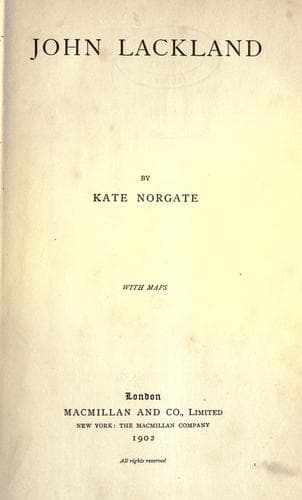
Great Britain -- History -- John, 1199-1216; Great Britain -- Kings and rulers -- Biography; John, King of England, 1167-1216
The archbishop of Rouen
received a promise from John and from the chancellor, each supported by
seven sureties, that they would keep this agreement. After it was drawn
up, a postscript appears to have been added: “If any thing should be
taken or intercepted by either party during the truce, it shall be
lawfully restored and amends made for it. And these things are done,
saving always the authority and commands of our lord the king; yet so
that if the king before his return should not will this agreement to be
kept, the aforesaid castles of Nottingham and Tickhill shall be given
up to Lord John, whatever the king may order concerning them.” The last
clause is obscure; but its meaning seems to be that if the arrangement
just made should prove to be, in the judgment of the king’s ministers,
untenable, it was to be treated as void, and matters were to be
restored to the position in which they had been before it was made.[147]
The contingency which seems to have been contemplated in this
postscript very soon occurred. Some mercenaries whom the chancellor had
summoned from over sea landed in England, and he at once repudiated
the agreement, declaring there should be no peace till either he or
John was driven out of the realm.[148] Hereupon it seems that Venneval
and the Marshal, in accordance with the clause above quoted, restored
the castles of Tickhill and Nottingham to John. On the other hand, an
outrage on John’s part, which is recorded only as having occurred some
time in this year (1191), certainly took place before October, and most
likely before the middle of September. Roger de Lacy, the constable
of Chester, who was responsible to Longchamp for the safe keeping of
these two castles, made a vigorous effort to bring to justice the
subordinate castellans to whom he had entrusted them, and who had
betrayed them to John. Of these there had been two in each castle.
Two managed to keep out of Lacy’s reach; the other two he caught and
hanged, although one of them offered to swear with compurgators that he
had never consented to the treason of his colleague, and even brought a
letter from John requesting that the compurgation might be allowed--the
chancellor, to whom the question had been referred, having remitted it
to the decision of Lacy. While this man’s body was hanging in chains,
his squire drove the birds away from it; whereupon Roger de Lacy hanged
the squire. Then John took upon himself to avenge them both, not only
by disseising Roger of all the lands which he held of him, but also by
ravaging the lands which Roger possessed elsewhere.[149]
Public-domain text, read in full here on John Shaqi.
Reviews
Reviews
No reviews yet
Be the first to share your thoughts on this work.
Join the Discussion
Join the discussion
Sign in to leave a comment or review.
Sign InorCreate an account