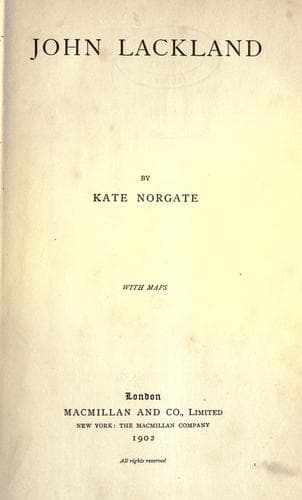
Great Britain -- History -- John, 1199-1216; Great Britain -- Kings and rulers -- Biography; John, King of England, 1167-1216
with a promise that they would acknowledge him as king if Richard
should die without issue.[173]
The barons, the bishops, the justiciars, all London, all England,
save a handful of Longchamp’s own relatives, personal friends and
followers, was on John’s side; Longchamp himself, besieged in the Tower
by overwhelming forces, could not possibly hold it for more than a day
or two, and there was no hope of relief. There was, however, still one
chance of escape from all his difficulties,--John might be bribed.
The project seemed a desperate one, for William had already tried it
without success, two days before;[174] yet he tried it again on the
Wednesday, and this time he all but succeeded. “By promising him much
and giving him not a little, the chancellor so nearly turned the count
of Mortain from his purpose that he was ready to withdraw from the
city, leaving the business unfinished, had not the bishops of Coventry
and York recalled him by their entreaties and arguments.”[175] Next day
the chancellor submitted. On the Friday {Oct. 11} he gave up the keys
of the Tower and of Windsor; within another fortnight he was reduced
to surrender all the other royal castles except the three which had
been nominally reserved to him, Dover, Cambridge, and Hereford.[176]
Hereupon John ordered him to be released, and allowed him to sail on
October 29 for France.[177]
[Sidenote: 1192]
The truth of Longchamp’s assertion that John was “endeavouring to usurp
the kingdom for himself” was soon made evident. Just before Christmas
Philip Augustus of France came home from Acre. After a vain attempt to
entrap the seneschal of Normandy into surrendering some of the border
fortresses of the duchy to him, he opened negotiations for Richard’s
damage in a more likely quarter; he invited John to come over and
speak with him immediately, proposing to put him in possession of “all
the lands of England and Normandy on this (_i.e._ the French) side
of the sea,” on one condition, that he should marry the bride whom
Richard had refused, Philip’s sister Adela.[178] To this condition
John’s existing marriage was a bar, but not an insuperable one; it
would be easy for him to divorce Isabel on the plea of consanguinity
if he were so minded. He responded eagerly to Philip’s invitation,
and was on the point of sailing from Southampton for France, when his
plans were upset by his mother’s landing at Portsmouth on February
11.[179] The French king’s treachery had come to Eleanor’s knowledge,
and she had hastened back to England to do what lay in her power for
the protection of her elder son’s interests. The justiciars, who seem
to have already had their suspicions of John’s loyalty, rallied round
her at once. She was in fact the only person whose right to represent
the absent king was treated by all parties as indisputable, although
she had never held any formal commission as regent. She and the
justiciars conjointly forbade John to leave the country, threatening
Public-domain text, read in full here on John Shaqi.
Reviews
Reviews
No reviews yet
Be the first to share your thoughts on this work.
Join the Discussion
Join the discussion
Sign in to leave a comment or review.
Sign InorCreate an account