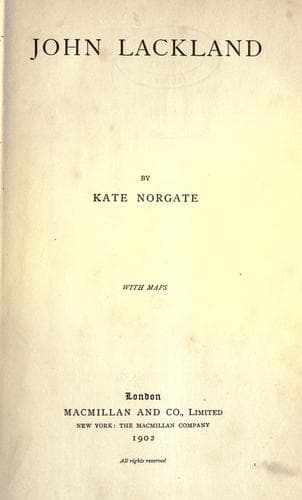
Great Britain -- History -- John, 1199-1216; Great Britain -- Kings and rulers -- Biography; John, King of England, 1167-1216
In Richard’s island realm there was never a moment’s question as to who
should succeed him on its throne. In English eyes one successor alone
was possible, no matter how undesirable he might be. The circumstances
of the case, however--the unexpectedness of the vacancy, the heir’s
absence from England, his past relations with the government and
the people there, and the existence of a rival claimant--presented
an opportunity for endeavouring to make a bargain with him such as
it was not often possible to make with a new sovereign. Accordingly
the English barons as a body, on hearing of Richard’s death, assumed
an attitude of independence. All of them set to work to fortify and
revictual their castles; some of them even began to attack and plunder
their neighbours, as if they deemed that there was to be again “no
king in the land”; and all the efforts of the justiciar, Geoffrey
Fitz-Peter, failed to restore order, till he was joined at the end of
April by Archbishop Hubert and William the Marshal. The archbishop
excommunicated the evildoers,[262] and he and the Marshal conjointly
tendered to all the men of the kingdom, “citizens and burghers, earls,
barons, and free tenants,” an oath of liege homage and fealty to John.
The lesser freemen apparently took it without hesitation, but many of
the barons held back. These reluctant ones--chief among whom were the
earls of Clare, Huntingdon, Chester, Ferrars and Warwick, Roger de Lacy
and William de Mowbray--were summoned by the primate, the Marshal and
the justiciar to a meeting at Northampton. There they took the oath,
but only in return for a promise given by the three ministers that if
they did so, John “should render to each of them his rights.”[263]
None of these “rights” are specified; but the expression used by the
historian who records the claim distinctly implies that it was in each
case the claim of an individual to some particular thing to which he
considered himself personally entitled, something, it would seem, which
he had been unable to obtain from the late king, and which he was
therefore anxious to secure beforehand from the new one. In several
cases the grievance seems to have been that of an heir who had not
yet received investiture of a dignity to which he had become entitled
by inheritance some time before.[264] With this grievance the Marshal
and the justiciar could not fail to sympathize; for although they had
for some years past enjoyed the estates attached to the earldoms of
Striguil (or Pembroke) and Essex respectively, neither of them had yet
been invested as earl. Justly, therefore, was the promise which they
had made in John’s name redeemed first of all to them when he girded
them with the earl’s sword and belt on his coronation day.[265]
Public-domain text, read in full here on John Shaqi.
Reviews
Reviews
No reviews yet
Be the first to share your thoughts on this work.
Elsewhere in the archive
Join the Discussion
Join the discussion
Sign in to leave a comment or review.
Sign InorCreate an account