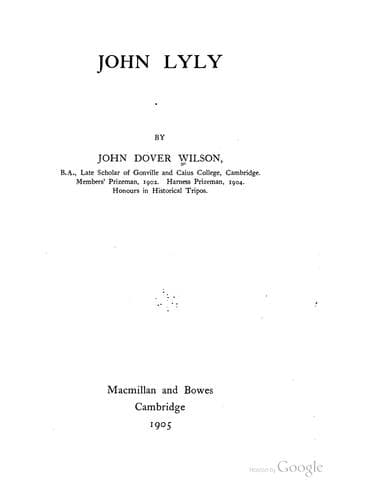
Lyly, John, 1554?-1606 -- Criticism and interpretation
Before undertaking the study of an artist, the critic should carefully
distinguish between these two critical methods. A complete study must of
course comprehend both; and in the case of Shakespeare, shall we say,
each should be exhaustive. On the other hand, there are artists whose
dynamical value is far greater than their intrinsic value, and _vice
versa_; and in such instances the critic must be guided in his action by
the relative importance of these values in any particular example. This
is so in the case of John Lyly. In the course of the following treatise
we shall have occasion to pass many aesthetic judgments upon his work;
but it will be from the historical side that we shall view him in the
main, because his importance for the readers of the twentieth century is
almost entirely dynamical. His work is by no means devoid of aesthetic
merit. He was, like so many of the Elizabethans, a writer of beautiful
lyrics which are well known to this day; but, though the rest of his
work is undoubtedly that of an artist of no mean ability, the beauty it
possesses is the beauty of a fossil in which few but students would
profess any interest. Moreover, even could we claim more for John Lyly
than this, any aesthetic criticism would of necessity become a secondary
matter in comparison with his importance in other directions, for to the
scientific critic he is or should be one of the most significant figures
in English literature. This claim I hope to justify in the following
pages; but it will be well, by way of obtaining a broad general view of
our subject, to call attention to a few points upon which our
justification must ultimately rest.
In the first place John Lyly, inasmuch as he was one of the earliest
writers who considered prose as an artistic end in itself, and not
simply as a medium of expression, may be justly described as a founder,
if not _the_ founder, of English prose style.
In the second place he was the author of the first novel of manners in
the language.
And in the third place, and from the point of view of Elizabethan
literature most important of all, he was one of our very earliest
dramatists, and without doubt merits the title of Father of English
Comedy.
Public-domain text, read in full here on John Shaqi.
Reviews
Reviews
No reviews yet
Be the first to share your thoughts on this work.
Join the Discussion
Join the discussion
Sign in to leave a comment or review.
Sign InorCreate an account