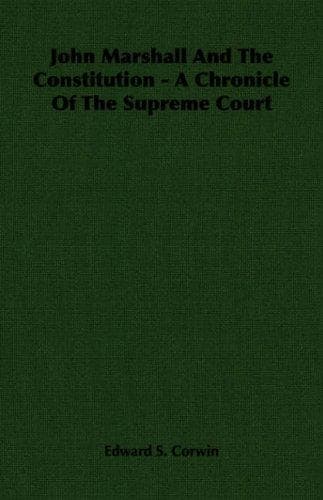
John Marshall and the Constitution, a Chronicle of the Supreme Court — John Shaqi
John Marshall and the Constitution, a Chronicle of the Supreme CourtCorwin, Edward Samuel
History
John Marshall and the Constitution, a Chronicle of the Supreme Court
Corwin, Edward Samuel
Constitutional history -- United States; Marshall, John, 1755-1835; United States. Supreme Court
Marshall was already one of the eminent men of the country when Adams,
without consulting him, nominated him for Chief Justice. He stood at the
head of the Virginia bar; he was the most generally trusted leader of
his party; he already had a national reputation as an interpreter of the
Constitution. Yet his appointment as Chief Justice aroused criticism
even among his party friends. Their doubt did not touch his intellectual
attainments, but in their opinion his political moderation, his
essential democracy, his personal amiability, all counted against him.
"He is," wrote Sedgwick, "a man of very affectionate disposition, of
great simplicity of manners, and honest and honorable in all his
conduct. He is attached to pleasures, with convivial habits strongly
fixed. He is indolent therefore. He has a strong attachment to
popularity but is indisposed to sacrifice to it his integrity; hence he
is disposed on all popular subjects to feel the public pulse, and hence
results indecision and an expression of doubt." ¹
¹ Op. cit.
It was perhaps fortunate for the Federal Judiciary, of which he was now
to take command, that John Marshall was on occasion "disposed ... to
feel the public pulse." A headstrong pilot might speedily have dashed
his craft on the rocks; a timid one would have abandoned his course; but
Marshall did neither. The better answer to Sedgwick's fears was given in
1805 when John Randolph declared that Marshall's "real worth was never
known until he was appointed Chief Justice." And Sedgwick is further
confuted by the portraits of the Chief Justice, which, with all their
diversity, are in accord on that stubborn chin, that firm placid mouth,
that steady, benignant gaze, so capable of putting attorneys out of
countenance when they had to face it overlong. Here are the lineaments
of self-confidence unmarred by vanity, of dignity without condescension,
of tenacity untouched by fanaticism, and above all, of an easy
conscience and unruffled serenity. It required the lodestone of a great
and thoroughly congenial responsibility to bring to light Marshall's
real metal.
CHAPTER III
Jefferson's War On The Judiciary
Public-domain text, read in full here on John Shaqi.
Reviews
Reviews
No reviews yet
Be the first to share your thoughts on this work.
Join the Discussion
Join the discussion
Sign in to leave a comment or review.
Sign InorCreate an account