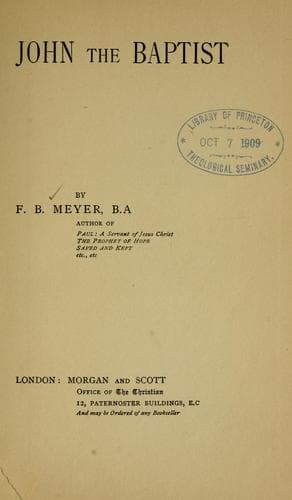
John the BaptistMeyer, F. B. (Frederick Brotherton)
Religion
John the Baptist
Meyer, F. B. (Frederick Brotherton)
Bible. New Testament -- Biography; John the Baptist, Saint
From the solitudes beyond the Jordan, as he walked with Elisha, talking
as they went, the chariot and horses of fire which the Father had sent
for his illustrious servant from heaven bore him homeward, while his
friends and disciples stood with outstretched hands, crying: The
chariot and horses of Israel are leaving us, bearing away our most
treasured leader. In those same solitudes, or within view of them, the
spirit of John the Baptist swept up in a similar chariot. As the
headsman, with a flash of his sword, put an end to his mortal career,
though no mortal eyes beheld them, and no chronicler has told the
story, there must have been horses and chariots of fire waiting to
convey the noble martyr-spirit to its God. The parallel is an
interesting one--it shows how God repeats Himself; and, if time and
space permitted, we might elaborate the repetition of a similar
conception, either in Savonarola of Florence, or in Martin Luther, or
in John Knox, who had been baptized into the same Spirit, and inspired
to perform the same ministry. That Spirit is waiting still--waiting to
clothe Himself with our life; waiting to do in us, and through us,
similar work for the time in which we live. What these men did far
back in the centuries, it is probable that others Will have to do
before this dispensation passes utterly away. A man, or men, shall
again rise up, who will tower over their fellows, who will speak and
act in the spirit and power of Elijah--men like Edward Irving, but
without the mistakes that characterized his heroic life. Perhaps some
young life may be inspired by this page to yield itself to God, so that
it may be sent forth to turn back the hearts and lives of vast
multitudes from their evil way, turning the heart of the fathers to
their children, and the heart of the children to their fathers, to make
ready a people prepared for the Lord.
II. NOTICE THE INFERIORITY OF THESE GREAT MEN TO THE LORD.--Neither
Elisha, the disciple of Elijah, nor the eloquent Apollos, the disciple
of John the Baptist, would have dared to say of their respective
masters what Philip and Andrew, Peter and Thomas, habitually said of
Christ. Greatly as they revered and loved their masters, they knew
that they were men like themselves; that their nature was made in the
same mould, though, perhaps, of finer clay; that there were limitations
beyond which they could not go, and qualities of mind and soul in which
they were not perfected. They dared not say of them, "My Lord and my
God." They never thought of prostrating themselves at their feet in
worship; they never appealed to them after their decease as able to
hear and answer prayer from the heaven into which they had passed.
Public-domain text, read in full here on John Shaqi.
Reviews
Reviews
No reviews yet
Be the first to share your thoughts on this work.
Elsewhere in the archive
Join the Discussion
Join the discussion
Sign in to leave a comment or review.
Sign InorCreate an account