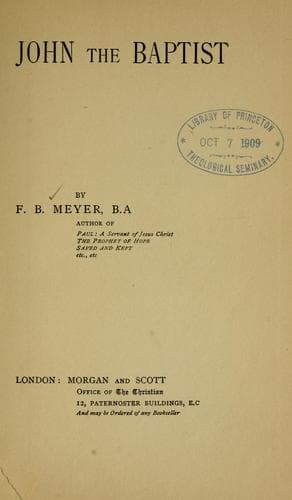
John the BaptistMeyer, F. B. (Frederick Brotherton)
Religion
John the Baptist
Meyer, F. B. (Frederick Brotherton)
Bible. New Testament -- Biography; John the Baptist, Saint
Neither Elijah nor John had what Jesus asserted--the consciousness of
an unique union with God; neither of them dared to affirm, as Jesus
did, that he was the Son of God, in the sense that made other use of
that term blasphemy; neither of them thought of anticipating a moment
when he should be seen sitting at the right hand of power, and coming
in the clouds; neither of them dared to couple himself with Deity in
the sublime and significant pronoun _we_--"We will come and make our
abode with Him." Neither of them would have dreamed of accepting the
homage which Jesus took quite naturally, when men worshipped Him, and
women washed and kissed his feet: and I ask how it could be that Jesus
Christ, so essentially meek and lowly, so humble and unwilling to
obtrude Himself, should have spoken and acted so differently, unless
his nature had been separated by an impassable gulf from that of other
men, however saintly and gifted? The very fact that these men,
acknowledged amongst the greatest of our race, drew a line, and said:
Beyond that we cannot pass; we are conscious of defilement and need; we
require forgiveness and grace, equally with those to whom we minister.
And this compels on our part the acknowledgment that Jesus Christ was
all He claimed to be, and that He is worthy to receive glory, and
honour, and riches, and power, and blessing; for He is Man of men, the
second Man, the Lord from Heaven.
Neither of these dared to offer himself as the Comforter and Saviour of
men. Elijah could only rebuke sin, which he did most strenuously; but
he had no panacea for the sin and sorrow of his countrymen. He could
bid them turn to God; and he did. But he could say nothing of any
inherent virtue, or power, which could proceed from him to save and
help. It was never suggested for a moment that he could act as
mediator between God and men, though he might be an intercessor. And
as for John the Baptist, though he deeply stirred the religious
convictions of his countrymen, he could only point to One who came
after him, and say: "Behold the Lamb of God, which taketh away the sin
of the world." But within six months after the commencement of his
ministry, Jesus says; "Son, thy sins are forgiven thee"; "The Son of
Man hath authority on earth to forgive sins"; "Daughter, thy sins,
which are many, are forgiven thee: go in peace"; and presently: "This
is the cup of the New Covenant in my blood, shed for many, for the
remission of sins", and again: "The Son of Man came to give his life a
ransom for many." Tell me of any, either in the story of Elijah or of
John the Baptist, to compare with these words, spoken by the lowest and
humblest being that ever trod time's sands? Does that not indicate
that He stood in a relationship to God and man which has never been
realized by another?
Public-domain text, read in full here on John Shaqi.
Reviews
Reviews
No reviews yet
Be the first to share your thoughts on this work.
Elsewhere in the archive
Join the Discussion
Join the discussion
Sign in to leave a comment or review.
Sign InorCreate an account