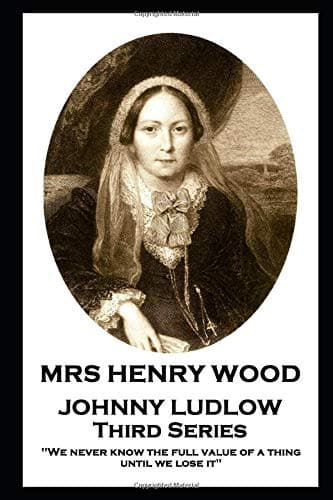
England -- Social life and customs -- 19th century -- Fiction; Short stories, English
No, she would not speak of her own accord, so he began to pump her.
Doing it very kindly and soothingly: had Jessy spent her year in London
robbing all the banks, one might have thought she could only have
yielded to his wish to come to the bottom of it. Duffham listened to her
answers, and sat with a puzzled face. She told him what she had told
Susan: that her post of lady's-maid had been too hard for her and worn
her to what she was; that she had shrunk from returning home on account
of her ingratitude, and should not have returned ever of her own will.
But she had yearned for a sight of the old place, and so came down by
rail, and walked over after dark. In passing the church she saw it
lighted up; and lingered, peeping in. She never meant to be seen; she
should have gone away somewhere before morning. Nothing more.
Nothing more! Duffham sat listening to her. He pushed back the pretty
golden hair (no more blue ribbons in it now), lost in thought.
"_Nothing_ more, Jessy? There must have been something more, I think, to
have brought you into this state. What was it?"
"No," she faintly said: "only the hard work I had to do; and the thought
of how I left my home; and--and my unhappiness. I was unhappy always,
nearly from my first entering. The work was hard."
"What was the work?"
"It was----"
A long pause. Mr. Duffham, always looking at her, waited.
"It was sewing; dress-making. And--there was sitting up at nights."
"Who was the lady you served? What was her name?"
"I can't tell it," answered Jessy, her cheeks flushing to a wild hectic.
The surgeon suddenly turned the left hand towards him, and looked at the
forefinger. It was smooth as ivory.
"Not much sign of sewing there, Jessy."
She drew it under the clothes. "It is some little time since I did any;
I was too ill," she answered. "Mr. Duffham, I have told you all there is
to tell. The place was too hard for me, and it made me ill."
It was all she told. Duffham wondered whether it was, in substance, all
she had to tell. He went down and entered the parlour with a grave face:
Mr. Page, his daughters, and John Drench were there. The doctor said
Jessy must have perfect rest, tranquillity, and the best of nourishment;
and he would send some medicine. Abigail put a shawl over her head, and
walked with him across the garden.
"You will tell _me_ what your opinion is, Mr. Duffham."
"Ay. It is no good one, Miss Abigail."
"Is she very ill?"
"Very. I do not think she will materially rally. Her chest and lungs are
both weak."
"Her mother's were before her. As I told you, Jessy looks to me just as
my mother used to look in her last illness."
Mr. Duffham went through the gate without saying more. The snow was
sparkling like diamonds in the moonlight.
"I think I gather what you mean," resumed Abigail. "That she is, in
point of fact, dying."
"That's it. As I truly believe."
They looked at each other in the clear light air. "But not--surely, Mr.
Duffham, not immediately?"
Public-domain text, read in full here on John Shaqi.
Reviews
Reviews
No reviews yet
Be the first to share your thoughts on this work.
Join the Discussion
Join the discussion
Sign in to leave a comment or review.
Sign InorCreate an account