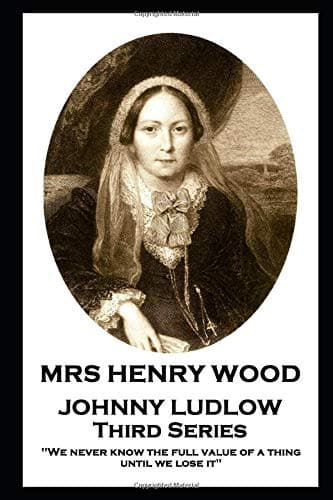
England -- Social life and customs -- 19th century -- Fiction; Short stories, English
People have their prejudices. It was not so much that these ladies
wished to cast reflection on good Catholics born and bred, as that Jessy
should have abandoned her own religion, just as though it had been an
insufficient faith. It was the slight on it that they could not bear.
"Miserable girl!" exclaimed Miss Susan, looking upon Jessy as a
turncoat, and therefore next door to lost. And Jessy told, through her
sobs, how it had come to pass.
Wandering about one evening in London when she was very unhappy, she
entered a Catholic place of worship styled an "Oratory."--The Miss
Pages caught up the word as "oratorio," and never called it anything
else.--There a priest got into conversation with Jessy. He had a
pleasant, kindly manner that won upon her and drew from her the fact
that she was unhappy. Become a Catholic, he said to her; it would bring
her back to happiness: and he asked her to go and see him again. She
went again; again and again. And so, going and listening to him, she at
length _did_ turn, and was received by him into his church.
"Are you the happier for it?" sharply asked Miss Abigail.
"No," answered Jessy with distressed eyes. "Only--only----"
"Only what, pray?"
"Well, they can absolve me from all sin."
"Oh, you poor foolish misguided child!" cried Abigail in anguish; "you
must take your sins to the Saviour: He can absolve you, and He alone.
Do you want any third person to stand between you and Him?"
Jessy gave a sobbing sigh. "It's best as it is, Abigail. Anyway, it is
too late now."
"Stop a bit," cried sharp Miss Susan. "I should like to have one thing
answered, Jessy. You have told us how hard you were kept to work: if
that was so, pray how did you find leisure to be dancing abroad to
Oratorios? Come?"
Jessy could not, or would not, answer.
"Can you explain that!" said Miss Susan, some sarcasm in her tone.
"I went out sometimes in an evening," faltered Jessy. And more than that
could not be drawn from her.
They did not tell Mr. Page: it would have distressed him too much. In a
day or two Jessy asked to see a priest. Miss Abigail flatly refused, on
account of the scandal. As if their minister was not good enough!
One afternoon I was standing by Jessy's bed--for Miss Abigail had let me
go up to see her. Mrs. Todhetley, that first day, had said she looked
like a lily: she was more like one now. A faded lily that has had all
its beauty washed out of it.
"Good-bye, Johnny Ludlow," she said, opening her eyes, and putting out
her feeble hand. "I shall not see you again."
"I hope you will, Jessy. I'll come over to-morrow."
"Never again in this world." And I had to lean over to catch the words,
and my eyes were full.
"In the next world there'll be no parting, Jessy. We shall see each
other there."
"I don't know," she said. "You will be there, Johnny; I can't tell
whether I shall be. I turned Roman Catholic, you see; and Abigail won't
let a priest come. And so--I don't know how it will be."
Public-domain text, read in full here on John Shaqi.
Reviews
Reviews
No reviews yet
Be the first to share your thoughts on this work.
Join the Discussion
Join the discussion
Sign in to leave a comment or review.
Sign InorCreate an account