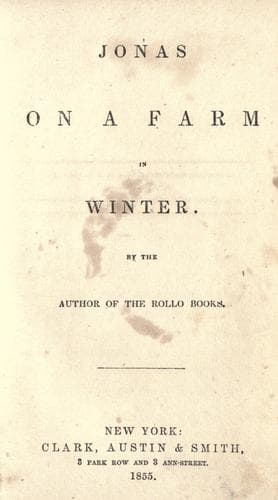
Animals -- Juvenile fiction; Boys -- Conduct of life -- Juvenile fiction; Farm life -- Juvenile fiction; Obedience -- Juvenile fiction
"Their fathers cannot generally give them enough to support them," said
Jonas, "even if they are disposed to do it; because, you see, they have
their own families still to support. Besides, if they were to divide
their property at once among all their children, it would only be a
small portion for each one. It wouldn't be enough for the boys to live
as expensively as they have been living while at home. Therefore, as
fast as they grow up young men, they have to go away into the world,
and earn their own money by some kind of work, head work or hand work."
Jonas would probably have given Oliver some further explanations on this
subject, were it not that about this time they arrived at the mill.
Oliver tied the horse at a post, while Jonas took out the great bundle
of wool, and went in. Oliver followed immediately after him.
The machinery made a heavy, rumbling sound, which grew louder and louder
as the boys went up stairs. Jonas opened a door into a large room, and
at this the noise increased very loudly, so that Oliver and Jonas could
hardly hear each other talk. Jonas put down the bundle of wool by the
door, and then he and Oliver went in among the wheels and machinery.
There were a great many separate machines at different parts of the
room, with girls tending them. There was a large, round beam of wood,
overhead, slowly revolving. There were wheels upon it in different
parts, with straps passing around these wheels, and also around other
wheels connected with the machines below.
Oliver saw Jonas walk to a man who was writing at a desk in the corner
of a room, and say something to him. Oliver could not hear what it was.
Jonas pointed, while he was talking to the man, to the great bundle of
wool. Presently the man came and took the bundle of wool, and dragged it
off to one of the machines, which was not in motion. He called a girl to
come and tend it.
At one end of the machine was a broad band of cloth, passing around two
rollers. One roller was close to the wheels and other large rollers of
the machine itself. The other was back from it a little; and the cloth,
being extended from one of these to the other, formed a sort of flat
table just before the machine.
Public-domain text, read in full here on John Shaqi.
Reviews
Reviews
No reviews yet
Be the first to share your thoughts on this work.
Join the Discussion
Join the discussion
Sign in to leave a comment or review.
Sign InorCreate an account