[Footnote 1: Derek Erez, ed. Goldberg, iii. 10.]
[Footnote 2: Moed Katon, 23a. See above, p. 177.]
[Footnote 3: Comp. Zunz, Gottesdienstliche Vortraege, pp. 154_ff_.]
The chronicle of Yosippon is a summary of Jewish history, with
considerable digressions--many of them later interpolations--about the
history of the nations with whom the Hebrew people came into contact,
Babylon, Greece, and Rome. Like the Book of Chronicles, it begins with
Adam and genealogies, explains the roll of the nations in Genesis, and
then springs suddenly from the legendary origin of Babel and Rome to the
relation of the Jews with Babylon. The history proper contains the
record of the Jews from the first to the second captivity, but is broken
by a mass of legendary material about Alexander the Great--reproducing
much of what is found in pseudo-Callisthenes--and by a short account of
the Carthaginian general Hannibal and several incidents of Roman
history. These include a description of a coronation of the Emperor,
which, it is suggested, applies to the medieval and not the classical
period of the Empire.
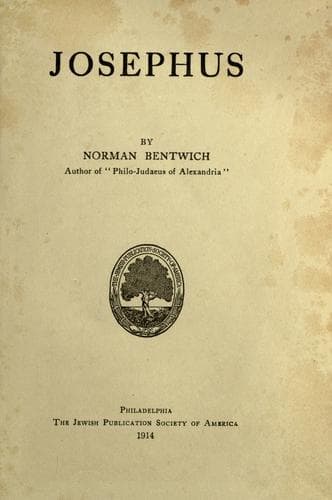
The book was known throughout the later part of the Middle Ages and down
to the eighteenth century as the Hebrew Josephus, and contrasted with
the [Hebrew: Yosifon la-Romim], or "Latin Josephus." When the genuine
works of our worthy became known to the Jews, Yosippon was regarded as
the true representative of the Jewish point of view against the
paganizing traitor. Its author had not a first-hand acquaintance with
our Josephus. He knew him only through the Latin versions, which were
mixed with much later material. Possibly he meant to pass off his work
as the Hebrew original of the Jewish history, and confused Joseph ben
Gorion with Joseph ben Mattathias; for in the introduction to one
manuscript we read, "I am Joseph, called Josephus the Jew, of whom it is
written that he wrote the book of the wars of the Lord, and this is the
sixth part." This, however, may be the gloss of a later scribe, who
found an anonymous book, and thought fit to supply the omission. In
places the Hebrew translator reproduces, though with some blunders, the
Latin Hegesippus, but he sought to give charm to his work by legendary
additions, which more often show Arabic and other foreign influences
than traces of the Jewish Haggadah. Interpolations have served to
increase the legendary element, and take away from the historical value.
But it is this element, reflecting the ideas of the age, that gives the
composition a peculiar literary interest.
Public-domain text, read in full here on John Shaqi.
Reviews
Reviews
No reviews yet
Be the first to share your thoughts on this work.
Elsewhere in the archive
Join the Discussion
Join the discussion
Sign in to leave a comment or review.
Sign InorCreate an account