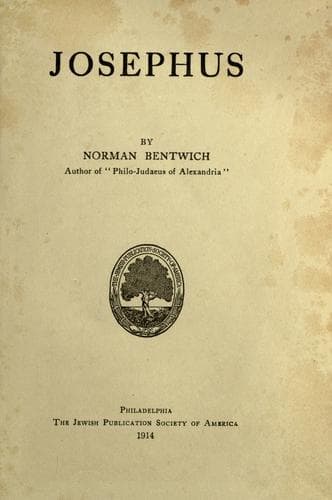
Josephus was little more than thirty years old at the time of his
surrender. At an age when men usually begin to realize their ambition
and ideal, his whole life's course was changed: he had to abandon all
his old associations, and accommodate himself to a different and indeed
a hostile society. Henceforth he was a liege of the Roman conqueror, and
had to submit to be Romanized not only in name but in spirit. His
condition was indeed a thinly-disguised servitude. The Romans were an
imperious as well as an Imperial people, and though in some
circumstances they were ready to spare the lives of those who yielded,
they required of them a surrender of opinion and an abasement of soul.
For the rest of his years, which comprehended the whole of his literary
activity, Josephus was not therefore a free man. He acted, spoke, and
wrote to order, compelled, whenever called upon, to do the will of his
masters. His legal condition was first that of a _libertus_ (a freedman)
of Vespasian, and as such he owed by law certain definite obligations to
his patron's family. But the moral subservience of the favored prisoner
of a subjugated people must have been a far profounder thing than the
legal obligation arising from his status; and this enforced moral and
mental subservience is a cardinal point to be remembered in forming a
judgment upon Josephus. His expressed opinions are often not the
revelation of his own mind, but the galling tribute which he was
compelled to pay for his life. And apart from the involuntary and
undeliberate adoption of Roman standards, which, living isolated from
Jewish life in Rome, he could not escape, he had in writing, and no
doubt in conversation, deliberately and consciously to assume the
deepest-seated of the Roman prejudices towards his own people. Liberty
has been defined as the power of a man to call his soul his own. And in
that sense Josephus emphatically did not possess liberty. We must be on
our guard, therefore, against regarding him as an independent historian,
much less as writing from an independent Jewish point of view. From the
time of his surrender till his death he lived and wrote as the client of
the Flavian house, and all his works had to pass the Imperial
censorship.
Public-domain text, read in full here on John Shaqi.
Reviews
Reviews
No reviews yet
Be the first to share your thoughts on this work.
Join the Discussion
Join the discussion
Sign in to leave a comment or review.
Sign InorCreate an account