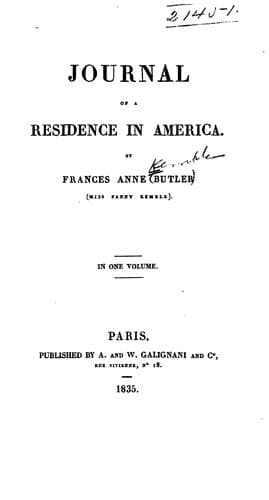
Atlantic States -- Description and travel; Kemble, Fanny, 1809-1893; United States -- Social life and customs -- 1783-1865
However, as I before said, my quarrel is not with those who condemn
indiscriminately all theatrical exhibitions; they may be right: at all
events, so sweeping a sentence betrays no inconsistency. But what are we
to say to individuals, or audiences, who turn with affected disgust from
the sallies of Bizarre and Beatrice, and who applaud and laugh, and are
delighted, at the gross immorality of such plays as the Wonder, and Rule
a Wife and have a Wife; the latter particularly, in which the immorality
and indecency are not those of expression only, but of conception, and
mingle in the whole construction of the piece, in which not one
character appears whose motives of action are not most unworthy, and
whose language is not as full of coarseness, as devoid of every
generous, elevated, or refined sentiment. (The tirades of Leon are no
exception; for in the mouth of a man who marries such a woman as
Marguerita, by such means, and for such an end, they are mere
mockeries.) I confess that my surprise was excited when I was told that
an American audience would not endure that portion of Beatrice's wit
which the London censors have spared, and that Othello was all but a
proscribed play; but it was infinitely more so, when I found that the
same audience tolerated, or rather encouraged with their presence and
applause, the coarse productions of Mrs. Centlivre and Beaumont and
Fletcher. With regard to the Inconstant, it is by far the most moral of
Farquhar's plays; that, perhaps, is little praise, for the Recruiting
Officer, and the Beaux' Stratagem, are decidedly the reverse. But in
spite of the licentiousness of the writing, in many parts, the
construction, the motive, the action of the play is not licentious; the
characters are far from being utterly debased in their conception, or
depraved in the sentiments they utter (excepting, of course, the
companions of poor Mirable's last revel); the women, those surest
criterions, by whose principles and conduct may be formed the truest
opinion of the purity of the social atmosphere, the women, though free
in their manners and language (it was the fashion of their times, and of
the times before them, when words did not pass for deeds, either good or
bad), are essentially honest women; and Bizarre, coarse as her
expressions may appear, has yet more _real_ delicacy than poor Oriana,
whose womanly love causes her too far to forget her womanly pride. Of
the catastrophe of this play, and its frightfully-pointed moral, little
need be said to prove that its effect is likely to be far more
wholesome, because far more homely, than that of most theatrical
inventions; invention, indeed, it is not, and its greatest interest, as
perhaps its chief utility, is drawn from the circumstance of its being a
faithful representation of a situation of unequalled horror, in which
the author himself was placed, and from which he was rescued precisely
as he extricates his hero. Of the truth and satirical power of the
Public-domain text, read in full here on John Shaqi.
Reviews
Reviews
No reviews yet
Be the first to share your thoughts on this work.
Elsewhere in the archive
Join the Discussion
Join the discussion
Sign in to leave a comment or review.
Sign InorCreate an account