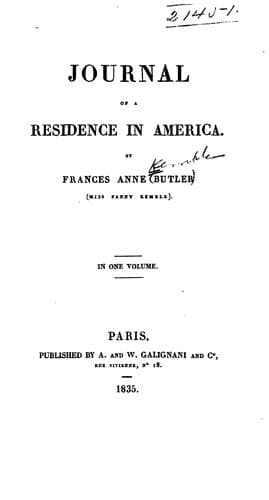
Atlantic States -- Description and travel; Kemble, Fanny, 1809-1893; United States -- Social life and customs -- 1783-1865
dialogue, none who understand it can dispute; and if, instead of
attaching themselves to the farcical romping of Bizarre and her
ungallant lover, the modest critics of this play had devoted some
attention to the dialogues between young and old Mirable, their nice
sense of decency would have been less shocked, and they might have found
themselves repaid by some of the most pointed, witty, and pithy writing
in English dramatic literature. I am much obliged to such of my friends
as lamented that I had to personate Farquhar's impertinent heroine; for
my own good part, I would as lief be such a one, as either Jane Shore,
Mrs. Haller, Lady Macbeth, or the wild woman Bianca. I know that great
crimes have a species of evil grandeur in them; they spring only from a
powerful soil, they are in their very magnitude respectable. I know that
mighty passions have in their very excess a frightful majesty, that
asserts the vigour of the natures from which they rise; and there is as
little similarity between them, and the base, degraded, selfish,
cowardly tribe of petty larceny vices with which human societies abound,
as there is between the caterpillar blight, that crawls over a fertile
district, gnawing it away inch-meal, and the thunderbolt that scathes,
or the earthquake that swallows the same region, in its awful mission of
destruction. But I maintain that freedom of expression and manner is by
no means an indication of laxity of morals, and again repeat that
Bizarre is free in her words, but not in her principles. The authoress
of the most graceful and true analysis of Shakspeare's female characters
has offered a better vindication of their manners than I could write; I
can only say, I pity sincerely all those who, passing over the exquisite
purity, delicacy, and loveliness of their conception, dwell only upon
modes of expression which belong to the times in which their great
creator lived. With respect to the manner in which audiences are
affected by what they hear on the stage, I cannot but think that
gentlemen, who wish their wives and daughters to hear no language of an
exceptionable nature, had better make themselves acquainted with what
they take them to see, or, at all events, avoid, when in the theatre,
attracting their attention to expressions which their disapprobation
serves only to bring into notice, and which had much better escape
unheard, or at least unheeded. Voluminous as this note has become, I
cannot but add one word with respect to the members of the profession to
which I have belonged. Many actresses that I have known, in the
performance of unvirtuous or unlovely characters (I cannot, however,
help remembering that they were also secondary parts), have thought fit
to impress the audience with the wide difference between their assumed
and real disposition, by acting as ill, and looking as cross as they
possibly could, which could not but be a great satisfaction to any moral
audience.
Public-domain text, read in full here on John Shaqi.
Reviews
Reviews
No reviews yet
Be the first to share your thoughts on this work.
Elsewhere in the archive
Join the Discussion
Join the discussion
Sign in to leave a comment or review.
Sign InorCreate an account