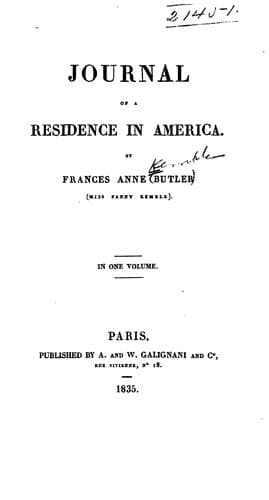
Atlantic States -- Description and travel; Kemble, Fanny, 1809-1893; United States -- Social life and customs -- 1783-1865
I have seen this done by that fine part in Milman's Fazio,
Aldabella, repeatedly, and not unfrequently by the Queen in Hamlet,
Margarita in Rule a Wife and have a Wife (I scarcely wonder at that,
though), and even by poor Shakspeare's Lady Falconbridge. I think this
is a mistake: the audience, I believe, never forget that the actress is
not indeed the wicked woman she seems. In one instance that might have
been the case, perhaps. I speak of a great artist, whose efforts I never
witnessed, but whose private excellence I have a near right to rejoice
in, and who was as true in her performance of the wretch Millwood, as in
her personifications of Shakspeare's grandest creations.
[22] The Russians and Danes are rich in the possession of an original
and most touching national music; Scotland, Ireland, and Wales, are
alike favoured with the most exquisite native melodies, probably, in the
world. France, though more barren in the wealth of sweet sounds, has a
few fine old airs, that redeem her from the charge of utter sterility.
Austria, Bohemia, and Switzerland, each claim a thousand beautiful and
characteristic mountain songs; Italy is the very palace of music,
Germany its temple; Spain resounds with wild and martial strains, and
the thick groves of Portugal with native music, of a softer and sadder
kind. All the nations of Europe, I presume all those of all the world,
possess some kind of national music, and are blessed by Heaven with some
measure of perception as to the loveliness of harmonious sounds. England
alone, England and her descendant America, seems to have been denied a
sense, to want a capacity, to have been stinted of a faculty, to the
possession of which she vainly aspires. The rich spirit of Italian
music, the solemn soul of German melody, the wild free Euterpe of the
Cantons, have in vain been summoned by turns to teach her how to listen;
'tis all in vain--she does listen painfully; she has learnt by dint of
time, and much endurance, the technicalities of musical science; she
pays regally her instructors in the divine pleasure, but all in vain:
the spirit of melody is not in her; and in spite of hosts of foreign
musicians, in spite of the King's Theatre, in spite of Pasta, in spite
of music-masters paid like ministers of state, in spite of singing and
playing young ladies, and criticising young gentlemen, England, to the
last day of her life, will be a dunce in music, for she hath it not in
her; neither, if I am not much mistaken, hath her daughter.
[23] It is but justice to state, that this house has passed into other
hands, and is much improved in every respect. Strangers, particularly
Englishmen, will find a great convenience in the five o'clock ordinary,
now established there, which is, I am told, excellently conducted and
appointed.
Public-domain text, read in full here on John Shaqi.
Reviews
Reviews
No reviews yet
Be the first to share your thoughts on this work.
Elsewhere in the archive
Join the Discussion
Join the discussion
Sign in to leave a comment or review.
Sign InorCreate an account