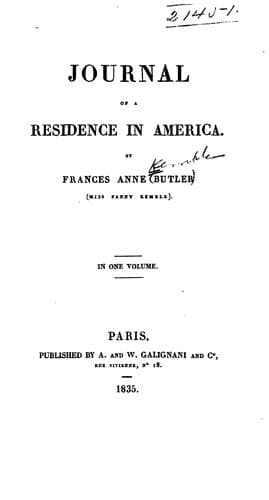
Atlantic States -- Description and travel; Kemble, Fanny, 1809-1893; United States -- Social life and customs -- 1783-1865
[36] I have often thought that the constant demand for small theatres,
which I have heard made by persons of the higher classes of society in
England, was a great proof of the decline of the more imaginative
faculties among them; and the proportionate increase of that fastidious
and critical spirit, which is so far removed from every thing which
constitutes the essence of poetry. The idea of illusion in a dramatic
exhibition is confined to the Christmas spectators of old tragedies and
new pantomimes; the more refined portions of our English audiences yawn
through Shakspeare's historical plays, and _quiz_ through those which
are histories of human nature and its awful passions. They have
forgotten what human nature really is, and cannot even _imagine it_.
They require absolute reality on the stage, because their incapable
spirits scoff at poetical truth; and that absolute reality, in our days,
consists in such representations as the Rent Day; or (crossing the
water, for we dearly love what is foreign) the homely improbabilities of
Victorine, Henriette, and a pack of equally worthless subjects of
exhibition. Indeed, theatres have had an end; for the refined, the
highly educated, the first classes of society, they have had an end; it
will be long, however, before the mass is sufficiently refined to lose
all power of imagination; and while our aristocracy patronise French
melodramas, and seek their excitement in the most trashy
sentimentalities of the modern _école romantique_, I have some hopes
that our plebeian pits and galleries may still retain their sympathy for
the loves of Juliet and the sorrows of Ophelia. I would rather a
thousand times act either of those parts to a set of Manchester
mechanics, than to the most select of our aristocracy, for they are
"nothing, if not critical."
[37] Kean is gone--and with him are gone Othello, Shylock, and Richard.
I have lived among those whose theatrical creed would not permit them to
acknowledge him as a great actor; but they must be bigoted, indeed, who
would deny that he was a great genius, a man of most original and
striking powers, careless of art, perhaps because he did not need it;
but possessing those rare gifts of nature, without which art alone is as
a dead body. Who that ever heard will ever forget the beauty, the
unutterable tenderness, of his reply to Desdemona's entreaties for
Cassio, "Let him come when he will, I can deny thee nothing;" the deep
despondency of his "Oh, now farewell;" the miserable anguish of his "Oh,
Desdemona, away, away!" Who that ever saw will ever forget the
fascination of his dying eyes in Richard, when, deprived of his sword,
the wondrous power of his look seemed yet to avert the uplifted arm of
Richmond. If he was irregular and unartistlike in his performances, so
is Niagara, compared with the water-works of Versailles.
Public-domain text, read in full here on John Shaqi.
Reviews
Reviews
No reviews yet
Be the first to share your thoughts on this work.
Elsewhere in the archive
Join the Discussion
Join the discussion
Sign in to leave a comment or review.
Sign InorCreate an account