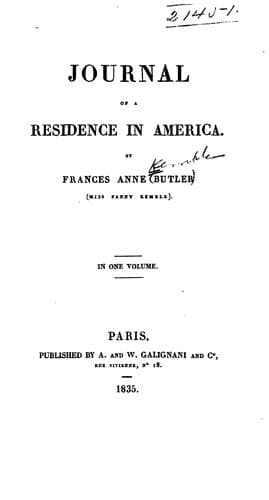
Atlantic States -- Description and travel; Kemble, Fanny, 1809-1893; United States -- Social life and customs -- 1783-1865
[38] I have acted Ophelia three times with my father, and each time, in
that beautiful scene where his madness and his love gush forth together
like a torrent swollen with storms, that bears a thousand blossoms on
its troubled waters, I have experienced such deep emotion as hardly to
be able to speak. The exquisite tenderness of his voice, the wild
compassion and forlorn pity of his looks bestowing that on others which,
above all others, he most needed; the melancholy restlessness, the
bitter self-scorning; every shadow of expression and intonation was so
full of all the mingled anguish that the human heart is capable of
enduring, that my eyes scarce fixed on his ere they filled with tears;
and long before the scene was over, the letters and jewel-cases I was
tendering to him were wet with them. The hardness of professed actors
and actresses is something amazing: after acting this part, I could not
but recall the various Ophelias I have seen, and commend them for the
astonishing absence of every thing like feeling which they exhibited.
Oh, it made my heart sore to act it.
[39] I am speaking now only of the common saddle-horses that one sees
about the streets and roads. The southern breed of race-horses is a
subject of great interest and care to all sporting men here: they are
very beautiful animals, of a remarkably slight and delicate make. But
the perfection of horses in this country are those trained for trotting:
their speed is almost incredible. I have been whirled along in a
light-built carriage by a pair of famous professed trotters, who
certainly got over the ground at the rate of a moderate-going
steam-engine, and this without ever for a moment breaking into a gallop.
The fondness of the Americans for this sort of horses, however, is one
reason why one can so rarely obtain a well-mouthed riding-horse. These
trotters are absolutely carried on the bit, and require only a snaffle,
and an arm of iron to hold them up. A horse well set upon his haunches
is not to be met with; and owing to this mode of breaking, their action
is entirely from the head and shoulders; and they both look and feel as
if they would tumble down on their noses.
Public-domain text, read in full here on John Shaqi.
Reviews
Reviews
No reviews yet
Be the first to share your thoughts on this work.
Elsewhere in the archive
Join the Discussion
Join the discussion
Sign in to leave a comment or review.
Sign InorCreate an account