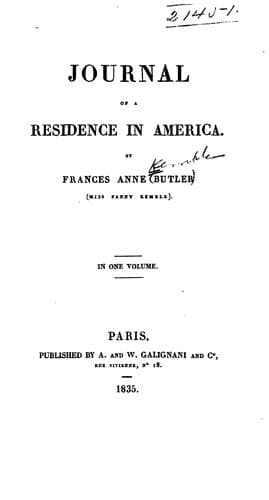
Atlantic States -- Description and travel; Kemble, Fanny, 1809-1893; United States -- Social life and customs -- 1783-1865
but the latter grew rank and long, unshorn and untidy. "Oh," thought I,
"for a pair of English shears, to make these green carpets as smooth and
soft and thick as the close-piled Genoa velvet." It looked neglected and
slovenly. Came home up Broadway, which is a long street of tolerable
width, full of shops, in short the American Oxford Road, where all
people go to exhibit themselves and examine others. The women that I
have seen hitherto have all been very gaily dressed, with a pretension
to French style, and a more than English exaggeration of it. They all
appear to me to walk with a French shuffle, which, as their pavements
are flat, I can only account for by their wearing shoes made in the
French fashion, which are enough in themselves to make a waddler of the
best walker that ever set foot to earth. Two or three were pretty girls;
but the town being quite empty, these are probably bad specimens of the
graces and charms that adorn Broadway in its season of shining. Came
home and had tea; after which my father, I, and Mr. ---- crossed the
Park (a small bit of grass enclosed in white palings, in plain English,
a green) to the theatre. Wallack was to act in the Rent Day. Mercy, how
strange I felt as I once more set foot in a theatre; the sound of the
applause set my teeth on edge. The house is pretty, though rather
gloomy, well formed, about the size of the Haymarket, with plenty of
gold carving, and red silk about it, looking rich and warm. The audience
was considerable, but all men; scarce, I should think, twenty women in
the dress circle, where, by the by, as well as in the private boxes, I
saw men sitting with their hats on. The Rent Day is a thorough
melodrama, only the German monster has put on a red waistcoat and top
boots. Nathless this is a good thing of a bad sort: the incidents,
though not all probable, or even as skilfully tacked together as they
might be, are striking and dramatically effective, and the whole piece
turns on those home feelings, those bitterest realities of every-day
life, that wring one's heart, beyond the pain that one allows works of
fiction to excite. As for the imitation of Wilkie's pictures, the first
was very pretty, but the second I did not see, my face being buried in
my handkerchief, besides having a quarter less seven fathom of tears
over it, at the time. I cried most bitterly during the whole piece; for
as in his very first scene Wallack asks his wife if she will go with him
to America, and she replies, "What! leave the farm?" I set off from
thence and ceased no more. The manager's wife and another woman were in
the box, which was his, and I thought we should have carried away the
front of it with our tears. Wallack played admirably: I had never seen
him before, and was greatly delighted with his acting. I thought him
handsome of a rustic kind, the very thing for the part he played, a fine
English yeoman: he reminded me of ----. At the end of the play, came
Public-domain text, read in full here on John Shaqi.
Reviews
Reviews
No reviews yet
Be the first to share your thoughts on this work.
Join the Discussion
Join the discussion
Sign in to leave a comment or review.
Sign InorCreate an account