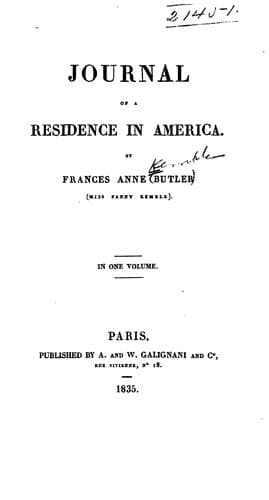
Atlantic States -- Description and travel; Kemble, Fanny, 1809-1893; United States -- Social life and customs -- 1783-1865
Rose at eight. After breakfast wrote journal, and practised for an hour.
---- called. I remember taking a great fancy to him about eight years
ago, when I was a little girl in Paris; but, mercy, how he is aged! I
wonder whether I am beginning to look old yet, for it seems to me that
all the world's in wrinkles. My father went out with him. Read a canto
in Dante; also read through a volume of Bryant's poetry, which Mr. ----
had lent us, to introduce us to the American Parnassus. I liked a great
deal of it very well; and I liked the pervading spirit of it much more,
which appears to me hopeful and bright, and what the spirit of a poet
should be; for in spite of all De Staël's sayings, and Byron's doings, I
hold that melancholy is _not_ essentially the nature of a poet. Though
instances may be adduced of great poets whose Helicon has been but a
bitter well of tears, yet, in itself, the spirit of poetry appears to me
to be too strong, too bright, too full of the elements of beauty and of
excellence, too full of God's own nature, to be dark or desponding; and
though from the very fineness of his mental constitution a poet shall
suffer more intensely from the baseness and the bitterness which are the
leaven of life, yet he, of all men, the most possesses the power to
discover truth, and beauty, and goodness, where they do exist; and where
they exist not, to create them. If the clouds of existence are darker,
its sunshine is also brighter to him; and while others, less gifted,
lose themselves in the labyrinth of life, his spirit should throw light
upon the darkness, and he should walk in peace and faith over the stormy
waters, and through the uncertain night; standing as 'twere above the
earth, he views with clearer eyes its mysteries; he finds in apparent
discord glorious harmony, and to him the sum of all is good; for, in
God's works, good still abounds to the subjection of evil. 'Tis this
trustful spirit that seems to inspire Bryant, and to me, therefore, his
poetry appears essentially good. There is not much originality in it. I
scarce think there can be, in poems so entirely descriptive: his
descriptions are very beautiful, but there is some sameness in them, and
he does not escape self-repetition; but I am a bad critic, for which I
thank God! I know the tears rolled down my cheeks more than once as I
read; I know that agreeable sensations and good thoughts were suggested
by what I read; I thought some of it beautiful, and all of it wholesome
(in contradistinction to the literature of this age), and I was well
pleased with it altogether. Afterwards read a sort of satirical
burlesque, called "Fanny," by Hallek: the wit being chiefly confined to
local allusions and descriptions of New York manners, I could not derive
much amusement from it.
* * * * *
* * * * *
Public-domain text, read in full here on John Shaqi.
Reviews
Reviews
No reviews yet
Be the first to share your thoughts on this work.
Join the Discussion
Join the discussion
Sign in to leave a comment or review.
Sign InorCreate an account