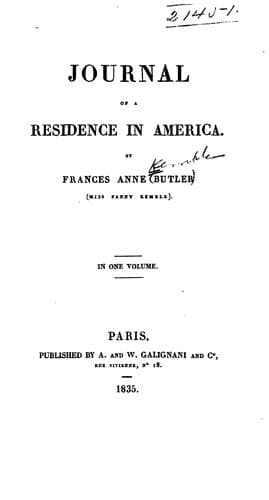
Atlantic States -- Description and travel; Kemble, Fanny, 1809-1893; United States -- Social life and customs -- 1783-1865
I am surprised at any body's ever questioning the real madness of
Hamlet: I know but one passage in the play which tells against it, and
there are a thousand that go to prove it. But leaving all isolated parts
out of the question, the entire colour of the character is the proper
ground from which to draw the right deduction. Gloomy, desponding,
ambitious, and disappointed in his ambition, full of sorrow for a dead
father, of shame for a living mother, of indignation for his ill-filled
inheritance, of impatience at his own dependent position; of a
thoughtful, doubtful, questioning spirit, looking with timid boldness
from the riddles of earth and life, to those of death and the mysterious
land beyond it; weary of existence upon its very threshold, and withheld
alone from self-destruction by religious awe, and that pervading
uncertainty of mind which stands on the brink, brooding over the unseen
may-be of another world; in love, moreover, and sad and dreamy in his
affection, as in every other sentiment; for there is not enough of
absolute passion in his love to make it a powerful and engrossing
interest; had it been such, the entireness and truth of Hamlet's
character would have been destroyed. 'Tis love indeed, but a pulseless
powerless love; gentle, refined, and tender, but without ardour or
energy; such are the various elements of Hamlet's character, at the very
beginning of the play: then see what follows. A frightful and unnatural
visitation from the dead; a horrible and sudden revelation of the murder
of the father for whom his soul is in mourning; thence burning hatred
and thirst of vengeance against his uncle; double loathing of his
mother's frailty; above all, that heaviest burden that a human creature
can have put upon him, an imperative duty calling for fulfilment, and a
want of resolution and activity to meet the demand; thence an unceasing
struggle between the sluggish nature and the upbraiding soul; an eternal
self-spurring and self-accusing: from which mental conflict, alone
sufficient to unseat a stronger mind, he finds relief in fits of
desponding musing, the exhaustion of overwrought powers. Then comes the
vigilant and circumspect guard he is forced to keep upon every word,
look, and action, lest they reveal his terrible secret; the suspicion
and mistrust of all that surround him, authorised by his knowledge of
his uncle's nature: his constant watchfulness over the spies that are
set to watch him; then come, in the course of events, Polonius's death,
the unintentional work of his own sword, the second apparition of his
father's ghost, his banishment to England, still haunted by his
treacherous friends, the miserable death of poor Ophelia, together with
the unexpected manner of his first hearing of it--if all these--the
man's own nature, sad and desponding--his educated nature (at a German
university), reasoning and metaphysical--and the nature he acquires from
Public-domain text, read in full here on John Shaqi.
Reviews
Reviews
No reviews yet
Be the first to share your thoughts on this work.
Join the Discussion
Join the discussion
Sign in to leave a comment or review.
Sign InorCreate an account