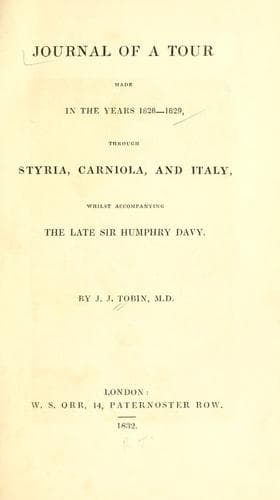
Journal of a Tour in the Years 1828-1829, through Styria, Carniola, and Italy, whilst Accompanying the Late Sir Humphry DavyTobin, J. J.
History
Journal of a Tour in the Years 1828-1829, through Styria, Carniola, and Italy, whilst Accompanying the Late Sir Humphry Davy
Tobin, J. J.
Davy, Humphry, Sir, 1778-1829; Europe -- Description and travel
_10th._ Our drive this morning from St. Goar to Bingen was cold and
rainy, and the Lurley rocks, and the wild and rugged banks of the
Rhine between St. Goar and Oberwesel, looked more than usually dreary,
the few vines and the little vegetation that appear upon them in
summer not having yet begun to shoot. We quitted the banks of the
Rhine at Bingen, and struck across the country through a fine rich
plain stretching almost as far as the eye can reach, and every here
and there diversified by low hills, to Mayence. Ingelheim, one of the
numerous residences of Charlemagne, and where that monarch once had
a magnificent palace, is now a little insignificant borough, and the
palace with its hundred columns from Rome or Ravenna, has vanished, or
nearly so, for the slight remains that are still standing, shew but
little of former grandeur.
At Mayence our passports were demanded at the first of the numerous
draw-bridges, and quickly _visé'd_. Sir Humphry determined upon
spending the night here, as I knew that the accommodations at the
Roman Emperor were much better than any he would find at Oppenheim
or Worms, which latter town we could not have reached till the night
had set in, and Sir Humphry does not like to travel after sunset. The
streets of this ancient town are for the most part narrow, dark, and
dirty, with the exception of the chief street running from the upper
part of the town towards the Rhine, called _die grosse bleiche_,
the great bleaching place, and which is a broad and handsome street.
The whole appearance of the town, the old _dom_ or cathedral, with
its heavy towers and light pinnacles of red stone; its brazen gates,
still bearing the marks of the balls of the celebrated siege in
1792; the many magnificent houses, often uninhabited or turned into
shops and _cafés_; the vast but ruinous palace of red sand-stone on
the Rhine; the few inhabitants one meets with in the streets,--the
officers and soldiers of the different regiments in garrison of
course excepted,--plainly tell the stranger that Mayence has no
longer any pretension to the splendour it owned under the rule of the
Ecclesiastical Princes, it being then the second ecclesiastical town
in Germany; or even during its occupation by the French, who, wherever
they went, were sure to carry with them life and spirit. As it has
changed for the worse, so may it again change for the better, and who
can say that it may not in a few lustres more again flourish as a
frontier fortress of France.
Public-domain text, read in full here on John Shaqi.
Reviews
Reviews
No reviews yet
Be the first to share your thoughts on this work.
Join the Discussion
Join the discussion
Sign in to leave a comment or review.
Sign InorCreate an account