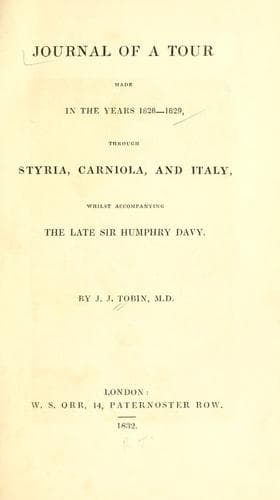
Journal of a Tour in the Years 1828-1829, through Styria, Carniola, and Italy, whilst Accompanying the Late Sir Humphry DavyTobin, J. J.
History
Journal of a Tour in the Years 1828-1829, through Styria, Carniola, and Italy, whilst Accompanying the Late Sir Humphry Davy
Tobin, J. J.
Davy, Humphry, Sir, 1778-1829; Europe -- Description and travel
_12th._ Sir Humphry finding himself too indisposed either to visit the
university, or to receive any of its eminent professors, some of whom
are very desirous to visit him, has determined to remain here only
till tomorrow; for it is painful to him to know that he is surrounded
by scientific men anxious to see and communicate with him, and to feel
that he is no longer able to enjoy their society, or that scientific
discussion, which, as it was formerly a source of the highest
gratification to him, "_now_," he says, "_only serves to make me feel
that I am but the shadow of what I was_." It is in vain to combat with
such feelings, but it is impossible not to regret their existence; for
could Sir Humphry be persuaded occasionally to mix more frequently in
such society, it would certainly rather be of service to him than not,
for his fine mind is still full of intellectual power and elasticity,
and he deceives himself in thinking otherwise. In the afternoon, as he
did not feel strong enough to mount the hill to the castle, he took a
short walk over the bridge along the northern banks of the Neckar, and
appeared much to enjoy the beautiful scenery that encircles this spot,
and is indeed every where to be found around Heidelberg. From this
side one sees the ancient ruin with its mouldering towers, backed by a
lofty amphitheatre of finely wooded mountains, with the town standing
immediately under it, and the broad river rushing through its light and
airy bridge, often foaming over many a rugged rock. The scene at all
times is beautiful and imposing, but when lighted up by the rays of the
setting sun, which fall with a resplendent glow upon the red-stone
walls and towers of the castle, the effect produced is very striking,
and at that hour it is impossible for the most indifferent observer
to pass the spot without admiration. The castle itself is now in a
very dilapidated state, for with the exception of the chapel, which
is merely a bare and lofty hall, there remains scarcely one entire
room; but the exterior walls of the quadrangle are nearly perfect, and
much of the sculpture that every where adorns the ruin is still in
high preservation, and some of the ruined towers, as such, are very
beautiful. The gardens too, which, from their situation, sweeping as
they do around the hill on which the castle stands, and abounding in
fine large trees, are at once commanding and beautiful, afford many a
delightful walk and striking view of the country beneath; and wandering
amid their risings and descents, one feels that here art has been
considered as she really is, the handmaid, not the mistress of nature's
works. From some of the terraces one looks directly down upon the town,
having a fine view beyond of the fertile plain between it and Mannheim,
through which the Neckar is seen winding till it joins the Rhine,
which, with the distant Vogesian mountains, bounds the view in the west.
Public-domain text, read in full here on John Shaqi.
Reviews
Reviews
No reviews yet
Be the first to share your thoughts on this work.
Join the Discussion
Join the discussion
Sign in to leave a comment or review.
Sign InorCreate an account